
In this article
An S-1 filing is how a US company tells the market everything it must disclose before selling shares to the public. The SEC calls it a registration statement; most of it is the prospectus, the document investors are supposed to read before they buy.
The S-1 is also the best free research document a fast-growing private company will ever publish. Anthropic's and CoreWeave's filings gave the public its first full set of audited numbers for each company. This page explains what is inside, how the filing changes on its way to an IPO, and which numbers to pull out, using those two AI-infrastructure filings as worked examples.
What's inside an S-1
Form S-1 has two parts. The SEC's own estimate of the average burden is 160.63 hours per filing.
| Part | What it covers | Where to look first |
|---|---|---|
| Part I: the prospectus | Cover page, summary and risk factors, use of proceeds, how the offering price was set, dilution, selling shareholders, plan of distribution (the underwriters), description of the shares, then the business, MD&A and audited financial statements | Summary, Risk factors, MD&A, Dilution |
| Part II: filed with the SEC only | Offering expenses, indemnification of directors, recent unregistered share sales, exhibits (key contracts) and undertakings | Exhibits, for material contracts |
The financial statements follow the SEC's Regulation S-X; the written disclosures follow Regulation S-K. The SEC also requires any other information needed so the filing isn't misleading.
From draft to final prospectus: the 6 steps
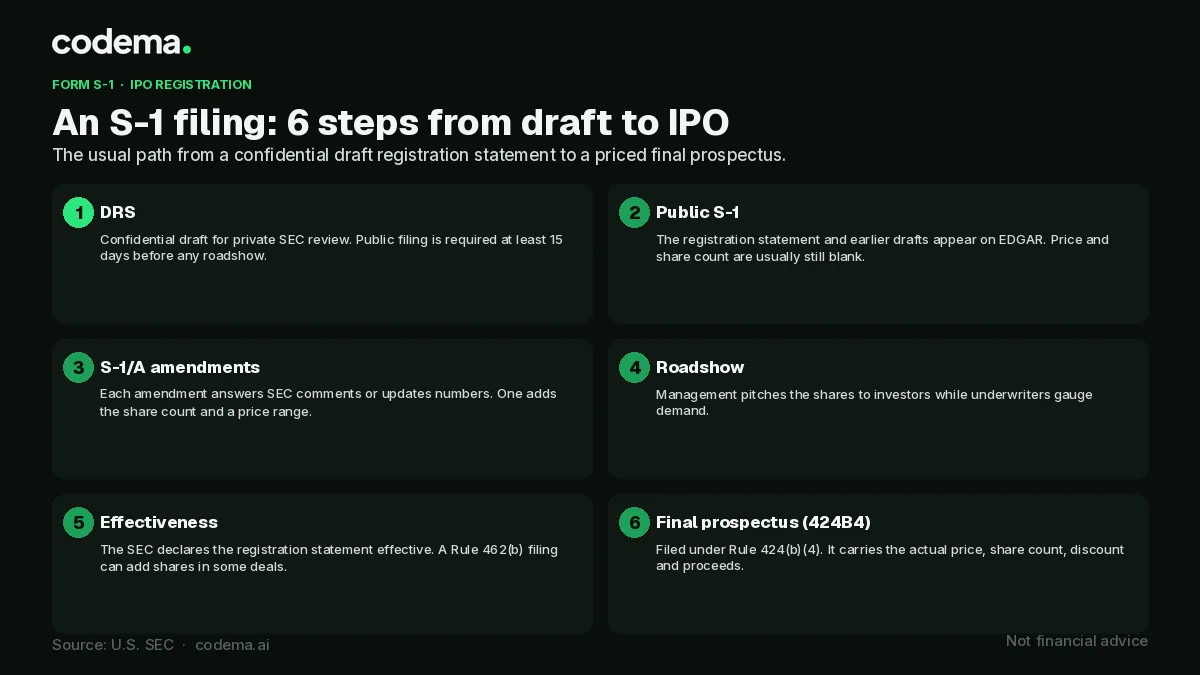
- Draft registration statement (DRS). The company submits a draft for private SEC review. The SEC has accepted these from all issuers since 2017, as long as the company files publicly at least 15 days before any roadshow.
- Public S-1. The registration statement and earlier drafts appear on EDGAR. The price and share count are usually still blank.
- S-1/A amendments. Each amendment answers SEC comments or updates numbers. One of them adds the share count and an estimated price range.
- Roadshow. Management pitches the shares to investors while underwriters gauge demand.
- Effectiveness. The SEC declares the registration statement effective. If demand lets the company sell more, a short Rule 462(b) filing can add shares worth up to 20% of the original maximum offering, effective on filing.
- Final prospectus (424B4). Filed under Rule 424(b)(4), it carries the actual price, share count, underwriting discount and proceeds. Trading starts around this point.
Other forms do related jobs: a foreign company uses Form F-1 instead, a company that is already public and eligible can use the shorter S-3, and an S-8 registers shares for employee plans. After listing, the company reports through 10-Qs and 10-Ks; our guide to reading a 10-Q picks up from there.
Worked example: Anthropic vs CoreWeave, filing by filing
Both AI-infrastructure IPOs followed the same path on EDGAR. The table below is built from each company's filing index and final prospectus.
| Anthropic (ANT) | CoreWeave (CRWV) | |
|---|---|---|
| First confidential draft (DRS) | Jun 1, 2026 | Dec 16, 2024 |
| Draft amendments | 5 | 2 |
| Public S-1 | Oct 26, 2026 | Mar 3, 2025 |
| S-1/A amendments | 3 (Nov 2, Nov 10, Nov 17) | 2 (Mar 12, Mar 20) |
| Price range in the S-1/A | $70.00 to $78.00, 825M shares | $47.00 to $55.00, 49M shares |
| Declared effective | Nov 18, 2026 | Mar 27, 2025 |
| Final price and shares (424B4) | $83.00, 980M shares | $40.00, 37.5M shares |
| Gross offering, before the extra-share option | $81.34B | $1.50B |
| Underwriters' option for extra shares | 147M shares | 5.625M shares |
| Underwriting discount per share | $0.56122 | $1.12 |
| Immediate dilution per share for new buyers | $73.30 | $36.74 |
| Risk factors section | pp. 30 to 124 | pp. 27 to 86 |
Sources: SEC EDGAR filing indexes, Anthropic's S-1/A No. 2 and 424B4, CoreWeave's Mar. 20 S-1/A and 424B4. Anthropic's 424B4 lists two registration numbers: it also filed a Rule 462(b) registration statement (S-1MEF) on Nov 18, the day the deal grew to 980M shares.
Our math: what the filings tell you
- How far the deal moved from the range. At the midpoint of its range, Anthropic's 825M shares would have raised about $61.05B. It sold 980M at $83, or $81.34B, about 33% more. CoreWeave went the other way: 49M shares at a $51 midpoint was about $2.50B; the final 37.5M at $40 raised $1.50B, about 40% less. The S-1/A range is a starting point, not a promise.
- What the banks charged. Anthropic's $0.56122 discount is about 0.68% of the $83 price ($550M on $81.34B). CoreWeave's $1.12 is 2.8% of $40.
- How much book value a new buyer gets. Dilution compares the IPO price with net tangible book value per share after the deal. Anthropic's $73.30 is about 88% of its $83 price; CoreWeave's $36.74 is about 92% of $40. In both cases, most of the IPO price sat above the book value of the assets behind each share.
- The extra-share option. Anthropic's 147M optional shares are 15% of the 980M base deal; CoreWeave's 5.625M are also 15% of 37.5M. Exercised in full, they take gross proceeds to about $93.5B (our math: 1,127M × $83).
How to read an S-1 in 30 minutes
- Cover page: shares, price or range, exchange and ticker, share classes and voting control.
- Summary: the company's own pitch and headline numbers.
- Risk factors: skim the headings; new or unusual ones are the signal.
- Use of proceeds: what the money is for, and how much goes to selling shareholders instead of the company.
- MD&A and financials: revenue growth, margins, cash burn and contractual commitments.
- Dilution and capitalization: what you get per share and who controls the votes.
- Shares eligible for future sale: lock-up length and how many shares unlock when.
For the Anthropic filing in detail, see our Anthropic IPO and S-1 explainer and the amended S-1's $17.0B quarter. For what CoreWeave does with the money it raised, see neoclouds explained and GPU-backed financing. OpenAI's president has said the company could be IPO-ready in 2027, which would start with exactly this filing.
Sources
FAQ
What is an S-1 filing in simple terms?
It is the document a company files with the US Securities and Exchange Commission to register shares it wants to sell to the public. Part I is the prospectus investors read; Part II holds extra information and exhibits filed only with the SEC.
What is the difference between an S-1 and an S-1/A?
An S-1/A is an amendment to the S-1. Companies file several as they answer SEC staff comments, update financials and add the share count and price range. Anthropic filed one S-1 and three S-1/A amendments before pricing; CoreWeave filed one S-1 and two amendments.
Is a confidential S-1 the same as a public S-1?
No. A draft registration statement (DRS) is reviewed privately by SEC staff. The SEC requires the company to file the registration statement and its drafts publicly at least 15 days before any roadshow, so investors see everything before shares are marketed.
Where can I read a company's S-1?
On SEC EDGAR. Search the company name, open its filing index and look for forms S-1, S-1/A and, after pricing, 424B4. SEC staff comment letters are posted no earlier than 20 business days after the registration statement becomes effective.
Does filing an S-1 mean a company will go public?
No. A filing only starts the process. A company can delay or withdraw it, and the offering happens only after the SEC declares the registration statement effective and the shares are priced.
Sources
- U.S. SEC, What is a Registration Statement? (Going public resources for small businesses)sec.gov
- U.S. SEC, Form S-1 and General Instructions (PDF)sec.gov
- U.S. SEC Division of Corporation Finance, Enhanced Accommodations for Issuers Submitting Draft Registration Statements (updated Mar. 3, 2025)sec.gov
- Investor.gov (SEC), Investor Bulletin: Investing in an IPO (PDF)investor.gov
- 17 CFR 230.462, Immediate effectiveness of certain registration statements (Rule 462), via Cornell LIIlaw.cornell.edu
- SEC EDGAR, Anthropic, PBC filing index (DRS through 424B4)sec.gov
- SEC EDGAR, Anthropic, PBC Form S-1/A, Amendment No. 2 (filed Nov. 10, 2026)sec.gov
- SEC EDGAR, Anthropic, PBC final prospectus, Rule 424(b)(4) (dated Nov. 18, 2026, filed Nov. 19, 2026)sec.gov
- SEC EDGAR, CoreWeave, Inc. filing indexsec.gov
- SEC EDGAR, CoreWeave, Inc. Form S-1/A with price range (filed Mar. 20, 2025)sec.gov
- SEC EDGAR, CoreWeave, Inc. final prospectus, Rule 424(b)(4) (dated Mar. 27, 2025)sec.gov
Topics
ANTCRWV
Carrie F.AI Money desk
Carrie F. is a Codema.ai house byline: a pen name used by our editorial desk, not one individual journalist. It covers AI Money: earnings from Big Tech and chipmakers, AI capital spending and how the build-out is financed, plus plain-English explainers such as free cash flow, EPS and how to read a 10-Q. It's news and analysis, not financial advice. Pieces under this name are written with AI assistance and reviewed by a human editor before they're published.
All stories by Carrie F.