
On November 10, 2026, CoreWeave said in its Q3 results release that third-quarter revenue was $3.661 billion, up 168% from $1.365 billion a year earlier (our math from the company's table), and raised its full-year 2026 revenue guidance to $13.0 billion to $13.3 billion. The same Nov. 10 release put revenue backlog at about $132.5 billion as of September 30, 2026, and raised the low end of 2026 capital-expenditure guidance, now $37 billion to $39 billion, from a prior range of $35 billion to $39 billion.
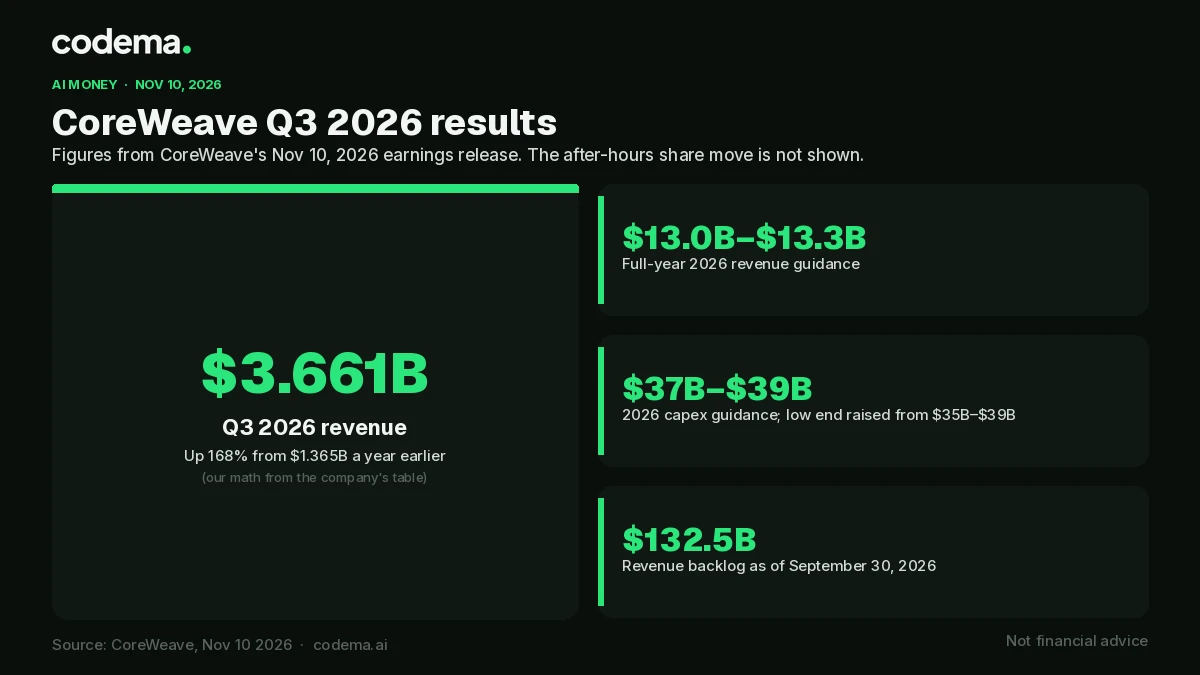
Those three Nov. 10 figures measure different things. The $13.0 billion to $13.3 billion guide is what CoreWeave now expects to recognize as revenue this year. The $37 billion to $39 billion capex range is what it expects to spend this year to put infrastructure in place, with the company saying it raised the low end because it expects to "deploy infrastructure and deliver it to customers sooner than planned." The $132.5 billion backlog is not this year's revenue. CoreWeave defines it as remaining performance obligations plus other amounts it estimates will be recognized in future periods under committed customer contracts, "subject to the satisfaction of delivery and availability of service requirements." Our explainer on backlog and RPO covers why that contracted total should not be read as cash already in the door, and our guide to reading capex keeps the spending line separate from revenue and from guidance.
The Nov. 10 release also shows why the quarter can look strong on revenue and still be tight on the income statement. Operating income was $207 million, or a 6% margin, against $52 million a year earlier. Adjusted operating income, a non-GAAP figure, was $379 million, or a 16% margin, which CEO Michael Intrator said reached "double digits a quarter ahead of plan." Net loss widened to $709 million, or $1.27 a share, from $110 million a year earlier, alongside net interest expense of $846 million, up from $310 million. CoreWeave guided fourth-quarter 2026 interest expense to $1.05 billion to $1.15 billion and raised full-year 2026 adjusted operating income guidance to $1.275 billion to $1.375 billion, which it said is a 26% increase at the midpoint versus its prior guide. It also raised annualized run-rate revenue guidance to $20 billion to $21 billion to exit 2026; the company defines that run rate as the last month of the quarter multiplied by 12, so it is not the same as full-year recognized revenue.
Cash spending stayed heavy. Purchases of property and equipment were $9.441 billion in the third quarter, per the Nov. 10 cash-flow statement, and operating cash flow was $1.975 billion. Intrator said growth is supported by financing backed by customer contracts, operating cash flow, "and approximately $9 billion in customer prepayments and deposits expected in the next three months alone." Recourse and non-recourse debt together were $46.873 billion as of September 30, 2026 (our math from the balance sheet: $9.183 billion and $1.389 billion current, plus $32.417 billion and $3.884 billion non-current). The company also said it raised about $4.2 billion in convertible senior notes, established an at-the-market program for up to 35 million Class A shares, and closed a $2.6 billion delayed-draw term loan facility for shorter-duration customer contracts.
The print landed after a sharp stretch for AI-infrastructure and neocloud names, which we covered in our recent chip and AI-spending sell-off recap. CNBC reported that CoreWeave shares advanced in extended trading after the Nov. 10 results. The company release does not give a share-price move, and CNBC's story as published did not state a percentage for that after-hours change. CoreWeave's own explainer context on neoclouds is useful for reading a specialist GPU cloud against the hyperscalers it both partners with and competes with.
What the Nov. 10 release does not say is also the watch list. It does not break the $132.5 billion backlog by customer or by the year it is expected to be recognized, and it does not state a prior backlog figure. It says it is raising 2026 revenue guidance but does not restate the prior revenue range in this release. It does not give a 2027 capex figure, even as this year's capex guide now sits several times above this year's revenue guide. Active power was more than 1.7 gigawatts after the company said it added more than 200 megawatts in the quarter, with contracted power above 4.6 gigawatts and a year-end active-power expectation of more than 1.85 gigawatts still in place. The test is whether that backlog converts on the timetable implied by the higher capex, and whether interest expense, which already exceeded operating income in the third quarter, stays manageable as the build-out continues.
Codema's AI Money hub follows earnings, capex and the financing behind the AI build-out. Our Hardware & Infra hub follows the power, chips and data-center capacity those contracts have to land on.
FAQ
What were CoreWeave's Q3 2026 results?
CoreWeave said revenue was $3.661 billion, up 168% from $1.365 billion a year earlier (Codema's math from the company's table). Operating income was $207 million, a 6% margin, and net loss widened to $709 million, or $1.27 a share, from $110 million.
What is CoreWeave's 2026 guidance?
It raised full-year revenue guidance to $13.0 billion to $13.3 billion and adjusted operating income guidance to $1.275 billion to $1.375 billion. Capital-expenditure guidance is now $37 billion to $39 billion, with the low end raised from $35 billion.
Is the $132.5 billion backlog the same as revenue?
No. CoreWeave defines backlog as remaining performance obligations plus other amounts it estimates will be recognized in future periods under committed customer contracts, "subject to the satisfaction of delivery and availability of service requirements." It is not this year's revenue or cash already received.
Why was net loss so large when revenue grew 168%?
Net interest expense was $846 million, up from $310 million a year earlier, against operating income of $207 million. CoreWeave guided fourth-quarter 2026 interest expense to $1.05 billion to $1.15 billion.
How much debt does CoreWeave have?
Recourse and non-recourse debt together were $46.873 billion as of September 30, 2026, by Codema's math from the balance sheet. The company also said it raised about $4.2 billion in convertible senior notes and closed a $2.6 billion delayed-draw term loan facility.
Sources
Topics

Carrie F.AI Money desk
Carrie F. is a Codema.ai house byline: a pen name used by our editorial desk, not one individual journalist. It covers AI Money: earnings from Big Tech and chipmakers, AI capital spending and how the build-out is financed, plus plain-English explainers such as free cash flow, EPS and how to read a 10-Q. It's news and analysis, not financial advice. Pieces under this name are written with AI assistance and reviewed by a human editor before they're published.
All stories by Carrie F.