
In this article
GPUs have become collateral. Neoclouds and AI data centre operators now borrow billions against the chips they buy, usually through a delayed-draw term loan (DDTL): a facility the borrower draws in stages as each batch of servers is delivered and accepted. Who lends, and at what price, has changed a lot since the first big deal in 2023.
For the mechanics, start with GPU-backed financing and SPVs explained. This page is about the lenders.
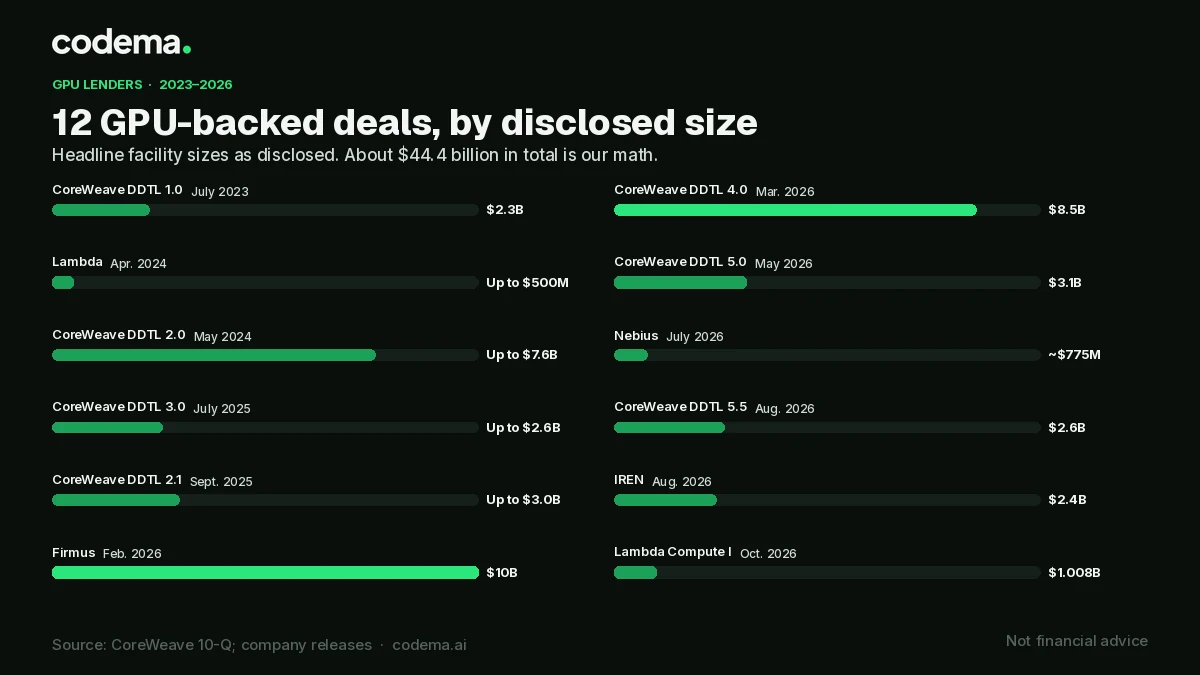
12 GPU-backed deals at a glance
| Borrower | Facility | Signed | Size | Lenders named | Pricing disclosed |
|---|---|---|---|---|---|
| CoreWeave | DDTL 1.0 | July 2023 | $2.3B | Magnetar, Blackstone | 15% effective |
| Lambda | GPU-backed facility | Apr. 2024 | Up to $500M | Macquarie, with Industrial Development Funding | Not disclosed |
| CoreWeave | DDTL 2.0 | May 2024 | Up to $7.6B | Blackstone, Magnetar, Carlyle, BlackRock and others | 11% effective |
| CoreWeave | DDTL 3.0 | July 2025 | Up to $2.6B | Not in 10-Q | 9% effective |
| CoreWeave | DDTL 2.1 | Sept. 2025 | Up to $3.0B | Not in 10-Q | 9% effective |
| Firmus | Debt facility | Feb. 2026 | $10B | Blackstone, Coatue | Not disclosed |
| CoreWeave | DDTL 4.0 | Mar. 2026 | $8.5B | MUFG, Morgan Stanley; anchored by Blackstone Credit & Insurance | SOFR + 2.25% or ~5.9% fixed; 7% effective |
| CoreWeave | DDTL 5.0 | May 2026 | $3.1B | Morgan Stanley (agent) | SOFR + 4.50%; 9% effective |
| Nebius | First secured facility | July 2026 | ~$775M | MUFG | SOFR + 2.50% |
| CoreWeave | DDTL 5.5 | Aug. 2026 | $2.6B | Not in 10-Q | Term SOFR + 5.50%; 11% effective |
| IREN | Compute equipment financing | Aug. 2026 | $2.4B | Blue Owl funds | Not in release |
| Lambda | Lambda Compute I DDTL | Oct. 2026 | $1.008B | Not named in release | Fixed rate |
Sources: CoreWeave's Q3 2026 10-Q (sizes, dates and "effective interest rates" as of Sept. 30, 2026), its DDTL 4.0 8-K and release; Reuters for the 2023 and 2024 CoreWeave lenders; Lambda 2024 and Greenberg Traurig; Firmus; Nebius; Blue Owl on IREN; Morningstar DBRS and Davis Polk on Lambda 2026. Sizes are headline commitments, not amounts drawn; "signed" is the month the facility was entered into. This is a list of deals with public terms, not every GPU loan.
The four kinds of GPU lender
Private credit funds. They took the first risk. Magnetar and Blackstone Tactical Opportunities led CoreWeave's 2023 facility, and Blackstone and Magnetar its 2024 one, with Carlyle, BlackRock and others, per Reuters. Blackstone and Coatue led Firmus's $10 billion facility for its Australian AI factories. Blue Owl funds led IREN's $2.4 billion loan for Nvidia Blackwell Ultra servers at its Mackenzie campus in British Columbia.
Banks. They arrived once there was a track record and a top-rated customer. MUFG and Morgan Stanley structured CoreWeave's $8.5 billion DDTL 4.0, with Goldman Sachs and JPMorgan as additional lead arrangers. MUFG led Nebius's first secured loan, with ABN AMRO, Bank of America, Deutsche Bank and HSBC as mandated lead arrangers.
Asset managers like Macquarie. Macquarie led Lambda's 2024 facility of up to $500 million. Lambda said at the time that the structure let it fund on-demand cloud capacity without its users signing long-term contracts, which is rare today.
Insurers and fixed-income investors. Lambda's October facility was, per its lawyers at Davis Polk, the first fixed-rate senior secured financing by a private neocloud with insurance companies and long-duration fixed-income investors. Blackstone's credit and insurance arm also anchored DDTL 4.0.
A fifth source sits on the borrower's own balance sheet: vendor financing. CoreWeave's 10-Q lists $6.9 billion of recourse "OEM and Software License Financing Arrangements" at a 10% effective rate, plus $770 million of non-recourse ones.
What decides the rate: the customer, not the chip
The cheapest deals all have a highly rated customer behind them. Moody's rated DDTL 4.0 A3 because it finances GB300 servers for a six-year take-or-pay contract with Meta, which Meta can't cancel for convenience. Nebius's SOFR + 2.50% loan is backed by cash flows from an investment-grade customer. Lambda's A (low)-rated loan funds more than 30,000 Nvidia GB300 and VR200 GPUs for two highly rated customers under take-or-pay contracts, per Morningstar DBRS.
The lenders also check cash cover. CoreWeave's DDTL 4.0 requires a debt service coverage ratio (DSCR) of at least 1.15x, meaning $1.15 of cash flow for every $1 of interest and principal due. Lambda's loan amortizes at a minimum 1.20x DSCR.
Our math
All figures below are our calculations from the sources above.
- Total disclosed: the 12 facilities add up to about $44.4 billion of headline commitments. CoreWeave's seven account for $29.7 billion, or about 67%.
- What falling rates are worth: at CoreWeave's effective rates, $1 billion of DDTL 1.0 debt costs about $150 million a year, DDTL 2.0 about $110 million, DDTL 3.0 about $90 million and DDTL 4.0 about $70 million. The 2026 investment-grade structure costs roughly half as much as the 2023 one.
- Credit spread gap: DDTL 4.0 pays SOFR + 2.25%; DDTL 5.5, signed about four months later, pays Term SOFR + 5.50%. The 3.25-point gap is about $32.5 million a year per $1 billion borrowed, before fees. Same borrower, same kind of asset; what changes is the contract behind each loan.
- Debt per GPU: Lambda's $1.008 billion over "more than 30,000" GPUs is at most about $33,600 of debt per GPU. Lambda's own equity covers part of the cost, per DBRS.
What to watch
- Rated deals. DDTL 4.0 and Lambda Compute I show insurers will buy GPU debt if a top-rated customer is locked in. More rated deals would lower costs across the sector.
- Customer concentration. Contract-backed loans are only as good as the contract. Anthropic's prospectus says much of its Lambda commitment is currently terminable; see CoreWeave vs Nebius vs Lambda.
- GPU prices and depreciation. If rental rates fall, collateral is worth less. Track them in our cost to rent an H100 or B300 piece.
- The wider bill. GPU loans are one slice of the AI build-out's financing; see who's paying for the $10 trillion build-out, neoclouds explained and our AI Money hub. The AI chips and memory guide covers the hardware being financed.
Sources
- CoreWeave: Form 10-Q, Q3 2026 (filed Nov. 12, 2026); DDTL 4.0 8-K and press release (Mar. 31, 2026)
- Moody's Ratings: A3 rating for CoreWeave Compute Acquisition Co. VIII (Mar. 31, 2026)
- Reuters: Private credit roundup (Oct. 16, 2026)
- Nebius: $775 million secured facility (July 17, 2026)
- Lambda: $500M GPU-backed facility (Apr. 4, 2024) and Greenberg Traurig (Apr. 12, 2024); Morningstar DBRS rating and Davis Polk (Oct. 1, 2026)
- Blue Owl: $2.4 billion IREN financing (Aug. 28, 2026)
- Firmus: US$10 billion financing (Feb. 9, 2026)
FAQ
Who lends against GPUs?
In the 12 disclosed deals we list, the lenders were private credit funds (Blackstone, Magnetar, Blue Owl, Coatue), banks (MUFG, Morgan Stanley, Goldman Sachs, JPMorgan, and the MUFG-led bank group behind Nebius's loan), Macquarie, and insurance and long-duration fixed-income investors in Lambda's 2026 fixed-rate loan.
What interest rate do GPU-backed loans pay?
It depends mainly on the customer. CoreWeave's 10-Q shows effective rates from 15% on its 2023 facility down to 7% on its 2026 investment-grade facility, which pays SOFR plus 2.25%. Nebius's 2026 loan backed by an investment-grade customer pays SOFR plus 2.50%.
What is the collateral in a GPU loan?
Usually the GPU servers plus the customer contract they serve, held in a separate subsidiary. CoreWeave's $8.5 billion DDTL 4.0 is secured by substantially all assets of one subsidiary, and Moody's says it finances GB300 servers for a six-year take-or-pay contract with Meta.
Can a small GPU cloud get financing?
Smaller fleets do get financed, but on different terms. Macquarie's 2024 facility of up to $500 million let Lambda finance GPUs without customers signing long-term contracts. Today's cheapest loans go to operators with signed contracts from investment-grade customers.
Sources
- CoreWeave, Form 10-Q for the quarter ended Sept. 30, 2026 (Note 10, Debt; filed Nov. 12, 2026)sec.gov
- CoreWeave, Form 8-K on the DDTL 4.0 Facility (filed Mar. 31, 2026)sec.gov
- CoreWeave, CoreWeave Closes Landmark $8.5 Billion Financing Facility, Achieving First Investment-Grade Rated GPU-backed Financing (Mar. 31, 2026)investors.coreweave.com
- Moody's Ratings, Moody's assigns A3 to CoreWeave Compute Acquisition Co. VIII, LLC (Mar. 31, 2026)ratings.moodys.com
- Reuters, Private credit roundup: CoreWeave's debt stress tests private credit's AI financing boom (Oct. 16, 2026)reuters.com
- Nebius, Nebius raises $775 million in first secured debt financing to accelerate global buildout (July 17, 2026)nebius.com
- Morningstar DBRS, Morningstar DBRS Assigns Credit Ratings of A (low) to Lambda Compute I LLC (Oct. 1, 2026)dbrs.morningstar.com
- Davis Polk, Lambda $1 billion senior secured delayed draw term loan financing (Oct. 1, 2026)davispolk.com
- Lambda via Business Wire, Lambda Announces $500M GPU-Backed Facility to Expand Cloud for AI (Apr. 4, 2024)businesswire.com
- Greenberg Traurig, Greenberg Traurig Represents Lambda in Securing $500M GPU-Backed Facility to Expand Cloud for AI (Apr. 12, 2024)gtlaw.com
- Blue Owl Capital, Blue Owl Managed Funds Lead $2.4 Billion AI Factory Financing for IREN (Aug. 28, 2026)blueowl.com
- Firmus, Firmus Secures US$10 Billion Financing led by Blackstone and Coatue (Feb. 9, 2026)firmus.co
Topics

Kelly B.AI Money desk
Kelly B. is a Codema.ai house byline: a pen name used by our editorial desk, not one individual journalist. It covers Hardware & Infra: GPUs and the memory inside them (HBM, GDDR7, DDR5, NAND), hardware for running AI locally, GPU rental prices, chipmaking, and the data centres and power behind AI. Pieces under this name are written with AI assistance and reviewed by a human editor before they're published.
All stories by Kelly B.