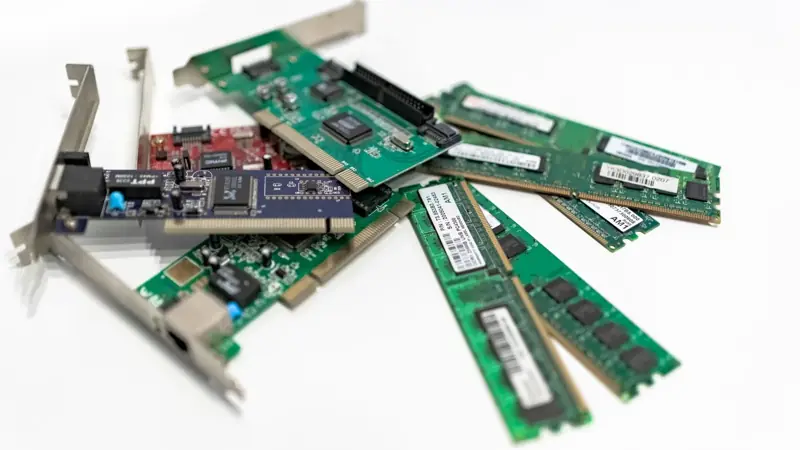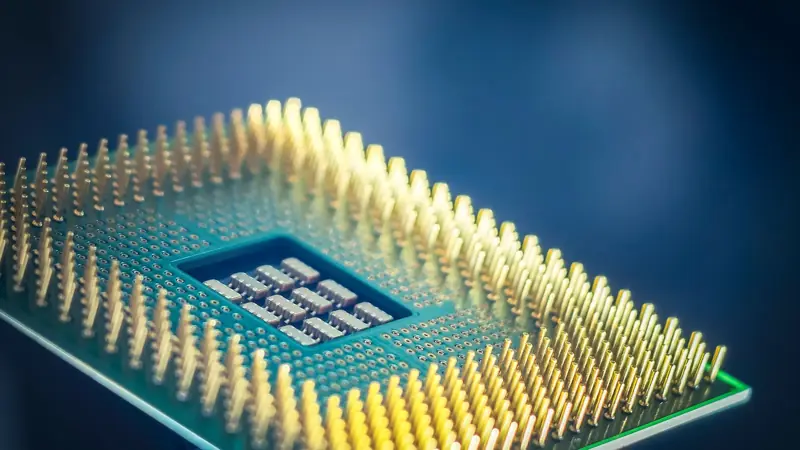

Every GPU needs very fast memory right next to it. Gaming cards and AI chips solve that in two different ways. Here's the plain version, using the official JEDEC standards.
The quick picture
- GDDR (GDDR6, GDDR7): separate memory chips arranged on the board around the GPU. Used in gaming cards like the RTX 50 series.
- HBM (HBM3E, HBM4): DRAM dies stacked into towers and packaged right beside the processor. Used in AI accelerators and data-center chips.
GDDR is the wide highway around the city. HBM is the skyscraper next door with thousands of elevators.
GDDR6 → GDDR7
JEDEC published the GDDR7 standard on March 5, 2024. Key changes:
- Double the bandwidth of GDDR6, up to 192 GB/s per device.
- PAM3 signalling: three voltage levels (+1, 0, −1) send 3 bits over 2 cycles, vs 2 bits for the older NRZ method.
- Independent channels double from 2 to 4.
- Densities of 16 to 32 Gbit per chip, plus on-die ECC for reliability.
Real-world example: the RTX 5090 has 32GB of GDDR7 with 1,792 GB/s of memory bandwidth.
HBM4
JEDEC released the HBM4 standard on April 16, 2025:
- A 2048-bit interface at up to 8 Gb/s, for up to 2 TB/s per stack.
- 32 channels per stack, double HBM3's 16.
- Stacks of 4, 8, 12 or 16 dies, up to 64GB per stack.
- Backwards compatible with HBM3 controllers.
Real-world example: Google's TPU7x (Ironwood) has 192 GiB of HBM per chip at about 7.37 TB/s.
Side by side
| GDDR7 (JEDEC) | HBM4 (JEDEC) | |
|---|---|---|
| Where it sits | chips around the GPU on the board | stacks beside the chip in the package |
| Bandwidth | up to 192 GB/s per device | up to 2 TB/s per stack |
| Signalling / bus | PAM3, narrow per chip | 2048-bit wide interface |
| Typical use | gaming and workstation GPUs | AI accelerators, HPC |
Why this matters for prices
Both kinds are now squeezed by AI:
- TrendForce says GDDR7 output is limited as capacity moves to server DRAM, and graphics DRAM prices keep rising in 4Q26.
- It also says HBM stays supply-constrained through 2027, with blended HBM prices projected up 121% YoY in 2027. Some GPU makers are considering 8-high stacks instead of 12-high to stretch supply, though 8-high costs about 10–20% more per Gb.
That's a big part of why the RTX 5090 costs so much and why consoles may get pricier (PS6 memory costs). For who makes HBM4, see the HBM4 race; for basics, our HBM explainer.