Part of our AI chips and memory explained: GPUs, TPUs and HBM guide
In this article
US export controls on chips decide which AI processors, memory and chipmaking tools can legally go to China, and on what terms. The Commerce Department's Bureau of Industry and Security (BIS) writes them into the Export Administration Regulations, and it has rewritten them almost every year since October 2022. This page tracks every major step, the technical limits each one sets, and the news that tests them. We update it in place as rules change.
Update, Nov. 27, 2026
Two stories this week show where the pressure is now.
- A Blackwell rack in Shanghai. Bloomberg reported that Shanghai Shuoyao pledged a GB300 NVL72 rack as collateral for a 96 million yuan loan from Shanghai Innovation Bank, based on November filings, and that the rack's serial number traces to Gigabyte. Shanghai Kezhan listed a GB200 server at the same site for a 90 million yuan loan in late 2025, Bloomberg said, adding that how the equipment reached China is unclear. Nvidia describes the GB300 NVL72 as a rack with 72 Blackwell Ultra GPUs. Blackwell chips are not covered by the January 2026 licence path, which applies only to the H200 and less advanced chips. Background: Nvidia board review of Huang.
- The Netherlands pushes back on the MATCH Act. The Dutch cabinet will try to block the proposed US law and, if it passes, ask Washington not to enforce it, trade minister Sjoerd Sjoerdsma said, according to Bloomberg on Nov. 26. The Netherlands is coordinating with the EU, Germany and France. H.R. 8170 would give allied supplier countries 150 days to match US controls on chipmaking equipment, and on servicing it, in China, or face US controls on their equipment. Congress.gov shows the House Foreign Affairs Committee ordered it reported 36 to 8 on Apr. 22, 2026. It is not law.
The timeline: every major rule since 2022
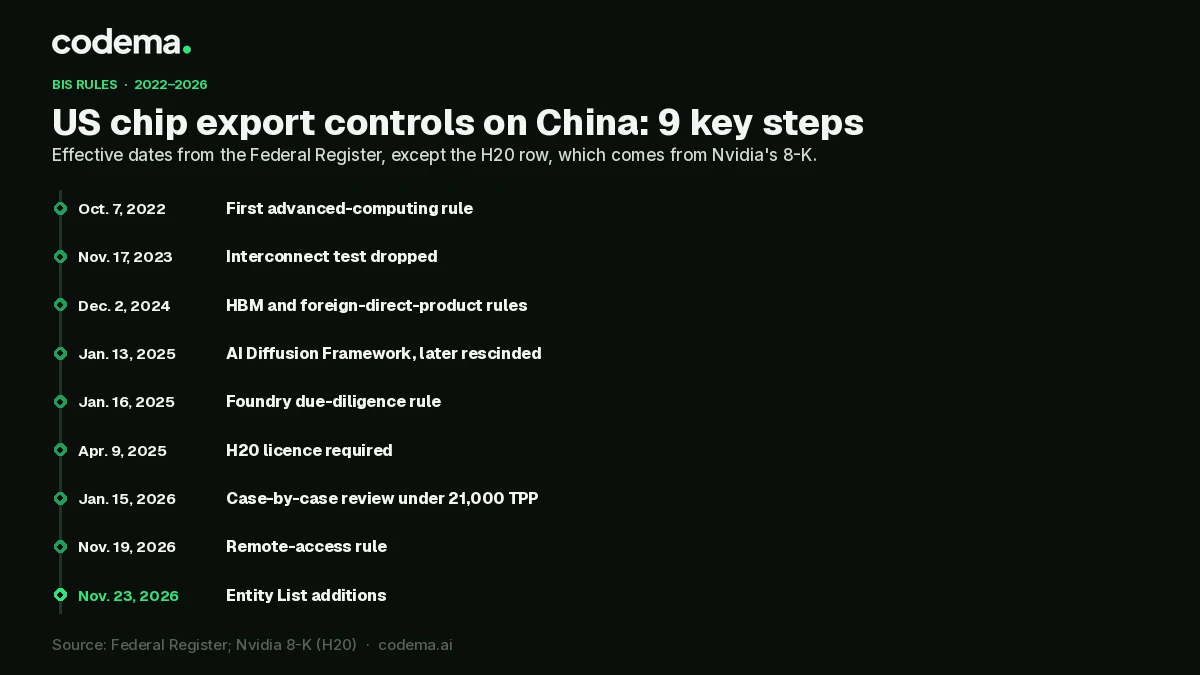
Each row comes from the rule's Federal Register text, except the H20 row, which comes from Nvidia's own filing. "D:5" is a BIS country group that includes China and Macau.
| Effective | Rule | What it restricts | Key threshold |
|---|---|---|---|
| Oct. 7, 2022 | 87 FR 62186 | Advanced AI chips (new ECCN 3A090), computers with them, some chipmaking tools; US persons supporting advanced chip production in China | TPP of 4,800 or more plus 600 GB/s chip-to-chip bandwidth |
| Nov. 17, 2023 | 88 FR 73458 | Drops the interconnect test so cut-down "China versions" are caught; adds performance density | TPP 4,800+, or TPP 1,600+ with performance density 5.92+ |
| Dec. 2, 2024 | 89 FR 96790 | High-bandwidth memory (new 3A090.c), more chipmaking tools, new foreign direct product rules | HBM above 2 GB/s per mm² of memory bandwidth density, which BIS said every HBM stack in production exceeds |
| Jan. 13, 2025 | 90 FR 4544 | AI Diffusion Framework: worldwide licence tiers and controls on closed model weights | Never enforced; formally rescinded Nov. 19, 2026 |
| Jan. 16, 2025 | 90 FR 5298 | Due diligence for foundries and packagers making advanced chips for others | Logic at 16/14nm or below presumed controlled unless cleared |
| Apr. 9, 2025 | US government notice to Nvidia (8-K) | Licence required for Nvidia's H20 to China, Hong Kong, Macau and D:5 | Any chip matching the H20's memory or interconnect bandwidth; Nvidia flagged up to about $5.5B of charges |
| Jan. 15, 2026 | 91 FR 1684 | H200, AMD MI325X and weaker chips move from presumption of denial to case-by-case review for China and Macau | TPP under 21,000 and total DRAM bandwidth under 6,500 GB/s, plus US lab testing of every shipment |
| Nov. 19, 2026 | 91 FR 74970 | Remote access by D:5-headquartered firms; licences for Indonesia, Malaysia, Singapore, Thailand and Brazil; fewer foundry pathways for China-based designers | 12,000,000 aggregate TPP per customer via a data centre; 90 days for existing providers |
| Nov. 23, 2026 | 91 FR 76148 | Seven Entity List additions in Malaysia, Singapore and Thailand, including Megaspeed units | All items subject to the EAR, presumption of denial |
The January 2026 rule is explained in detail in the H200 China export rule, explained. Why memory is its own control lever: HBM explained.
Our math: what the thresholds mean in real chips
TPP (total processing performance) is roughly a chip's dense tera-operations per second times the bit length of the operation. Using Nvidia's published specs, with the sparsity figures halved to dense:
- Why the A100 was caught in 2022. The A100 does 312 dense FP16 teraflops. 312 × 16 = 4,992 TPP, just over the 4,800 line.
- How much room the H200 has under the 2026 cap. The H200 lists 1,979 FP16 teraflops with sparsity, so 989.5 dense. 989.5 × 16 = 15,832 TPP, about 75% of the 21,000 cap. Its 4.8 TB/s of memory bandwidth is about 74% of the 6,500 GB/s cap.
- The size of the remote-access trigger. 12,000,000 aggregate TPP ÷ 15,832 = about 758 H100- or H200-class GPUs. That's about 95 eight-GPU servers, a modest cluster by data-centre standards. Newer, faster GPUs reach the line with fewer chips.
These are our calculations from the public specs, not BIS classifications. A licence decision depends on the exact product and the buyer.
What the November 2026 rules change
The Nov. 19 rule closes the two routes that the earlier rules left open.
- Cloud rental. Past BIS advisory opinions treated renting out cloud compute as outside export rules, CSIS notes. The new rule controls exports to overseas data centres that supply significant compute to companies headquartered in D:5 countries or Macau. Commercial recommender systems are exempt.
- Transshipment. A licence is now needed for advanced chips going to Indonesia, Malaysia, Singapore, Thailand and Brazil, unless the buyer is a US-headquartered company that meets reporting rules. Within a week, Nvidia had told partners to stop shipping servers to four of those countries, the FT reported.
- Foundries. Chinese designers can no longer have TSMC or a packager vouch that a 16nm-or-smaller chip falls outside the controls. TSMC halted those orders unless the customer holds a licence.
Comments on the rule are due Jan. 19, 2027.
Enforcement: where the rules are being tested
- Licensed sales. A BIS summary dated May 11, 2026, disclosed by the House Foreign Affairs Committee, shows 879,868 H200 and MI325X chips approved for Chinese companies, and California's attorney general has subpoenaed Nvidia. The New York Times found empty offices behind some H200 licensees, and Reuters reported that a blacklisted university bought two H200s.
- Nvidia's own guidance. CFO Colette Kress said on the Nov. 18 call that Nvidia is no longer shipping licensed Hopper data-centre products to China; see our Nvidia Q3 results.
- Chinese models. An outside analysis says six Chinese open-weight models show Blackwell fingerprints, though it says that doesn't show where the chips were. Chinese labs keep shipping: Qwen4-Max preview, Tencent Hy4 Flash and the 770B Hy4. Reuters tied GLM-5.5's delay partly to the chip curbs.
- China's side. Beijing is drafting its own AI export controls and building memory supply through CXMT.
For how the chips, memory and foundries fit together, start with our AI chips and memory guide.
Sources
- Federal Register (BIS): Oct. 2022 rule, Oct. 2023 rule, Dec. 2024 HBM and FDP rule, AI Diffusion Framework, foundry due diligence rule, H200 licence rule, remote access rule, Nov. 2026 Entity List additions
- NVIDIA: Form 8-K on the H20, H200 specs, A100 specs, GB300 NVL72
- Congress.gov: H.R. 8170, MATCH Act
- CSIS: New export controls on remote access
- Bloomberg: Netherlands to fight MATCH Act (Nov. 26, 2026), Blackwell chips at a Shanghai site (Nov. 27, 2026)
FAQ
Which Nvidia chips can be sold to China?
None without a US export licence. Since Jan. 15, 2026, licences for H200-class chips (under 21,000 TPP and 6,500 GB/s of memory bandwidth) get case-by-case review if strict conditions are met. Newer Blackwell chips are not covered. Nvidia's CFO said on Nov. 18 that it is no longer shipping licensed Hopper data-centre products to China.
What is TPP in US export controls?
Total processing performance, the Commerce Department's measure of a chip's compute: roughly its dense tera-operations per second multiplied by the bit length of the operation. The 2022 rule caught chips at 4,800 TPP and above; the 2026 H200 rule allows case-by-case review only below 21,000.
Can Chinese companies rent Nvidia GPUs in the cloud abroad?
Not at scale without a licence since Nov. 19, 2026. The remote-access rule requires a licence for exports to data centres that supply more than 12,000,000 aggregate TPP of compute to companies headquartered in China, Macau or other D:5 countries. Existing providers had 90 days to get one.
What is the MATCH Act?
H.R. 8170, a House bill that would push allies such as the Netherlands and Japan to match US controls on chipmaking equipment sold to and serviced in China within 150 days, or face US controls applied to their equipment. It is not law. The Dutch government says it will try to block it.
How do banned Nvidia chips still reach China?
Reported routes include smuggling through third countries, shell-company buyers and renting overseas cloud capacity. Bloomberg reported on Nov. 27 that a GB300 NVL72 rack was pledged as loan collateral in Shanghai, though how it got there is unclear. The November rules target the cloud and Southeast Asia routes.
Sources
- Federal Register, Implementation of Additional Export Controls: Certain Advanced Computing and Semiconductor Manufacturing Items (87 FR 62186, Oct. 13, 2022)federalregister.gov
- Federal Register, Implementation of Additional Export Controls: Certain Advanced Computing Items; Supercomputer and Semiconductor End Use; Updates and Corrections (88 FR 73458, Oct. 25, 2023)federalregister.gov
- Federal Register, Foreign-Produced Direct Product Rule Additions, and Refinements to Controls for Advanced Computing and Semiconductor Manufacturing Items (89 FR 96790, Dec. 5, 2024)federalregister.gov
- Federal Register, Framework for Artificial Intelligence Diffusion (90 FR 4544, Jan. 15, 2025)federalregister.gov
- Federal Register, Implementation of Additional Due Diligence Measures for Advanced Computing Integrated Circuits (90 FR 5298, Jan. 16, 2025)federalregister.gov
- NVIDIA Corporation, Form 8-K on the H20 license requirement (filed Apr. 15, 2025)sec.gov
- Federal Register, Revision to License Review Policy for Advanced Computing Commodities (91 FR 1684, Jan. 15, 2026)federalregister.gov
- Federal Register, Addressing Remote Access to Advanced Semiconductors (91 FR 74970, Nov. 19, 2026)federalregister.gov
- Federal Register, Additions to the Entity List (91 FR 76148, Nov. 25, 2026)federalregister.gov
- Congress.gov, H.R. 8170, MATCH Act (119th Congress)congress.gov
- Bloomberg, Netherlands to Fight Rollout of Proposed US Curbs on ASML (Nov. 26, 2026)bloomberg.com
- Bloomberg, Nvidia Blackwell chips turn up at China site tied to Alice Huang (Nov. 27, 2026)bloomberg.com
- CSIS, New Export Controls on Remote Access: The Implications for Industry and Competition with China (Nov. 2026)csis.org
- NVIDIA, H200 Tensor Core GPU specificationsnvidia.com
- NVIDIA, A100 Tensor Core GPU specificationsnvidia.com
Topics

Derrick K.Hardware & Infra desk
Derrick K. is a Codema.ai house byline: a pen name used by our editorial desk, not one individual journalist. It covers Build: hands-on guides for coding agents like Claude Code, Codex and OpenCode, LLM API pricing, rate limits and prompt caching, evals and prompt injection, and running open models locally. Pieces under this name are written with AI assistance and reviewed by a human editor before they're published.
All stories by Derrick K.