

Part of our AI chips and memory explained: GPUs, TPUs and HBM guide
Chinese AI companies are trying to rent Nvidia-powered computing capacity at data centers outside China, concerned that a scandal involving CEO Jensen Huang could spur Washington to tighten restrictions on their remote use of advanced processors, three people familiar with the matter told Reuters in an exclusive published November 12. Reuters did not name the companies involved.
What the remote-access loophole is
US rules already restrict exports to China of Nvidia's most advanced AI chips. Those controls are aimed at physical shipments. Chinese companies can still use the same processors remotely by renting computing power at data centers overseas, Reuters reported. That gap is the remote-access loophole. Our H200 export-controls explainer covers the license path for selling certain chips into China, and our AI chips and memory guide is the broader hardware backdrop.
A major Chinese cloud provider has discussed internally whether to lock in overseas Nvidia chip capacity, and some companies have contacted data-center operators about reserving it, the people said. They declined to identify the cloud provider because of the sensitivity of the matter. Smaller AI labs are considering similar steps, including approaching major providers of rented computing power in Southeast Asia, two of the people said.
Where the Remote Access Security Act stands
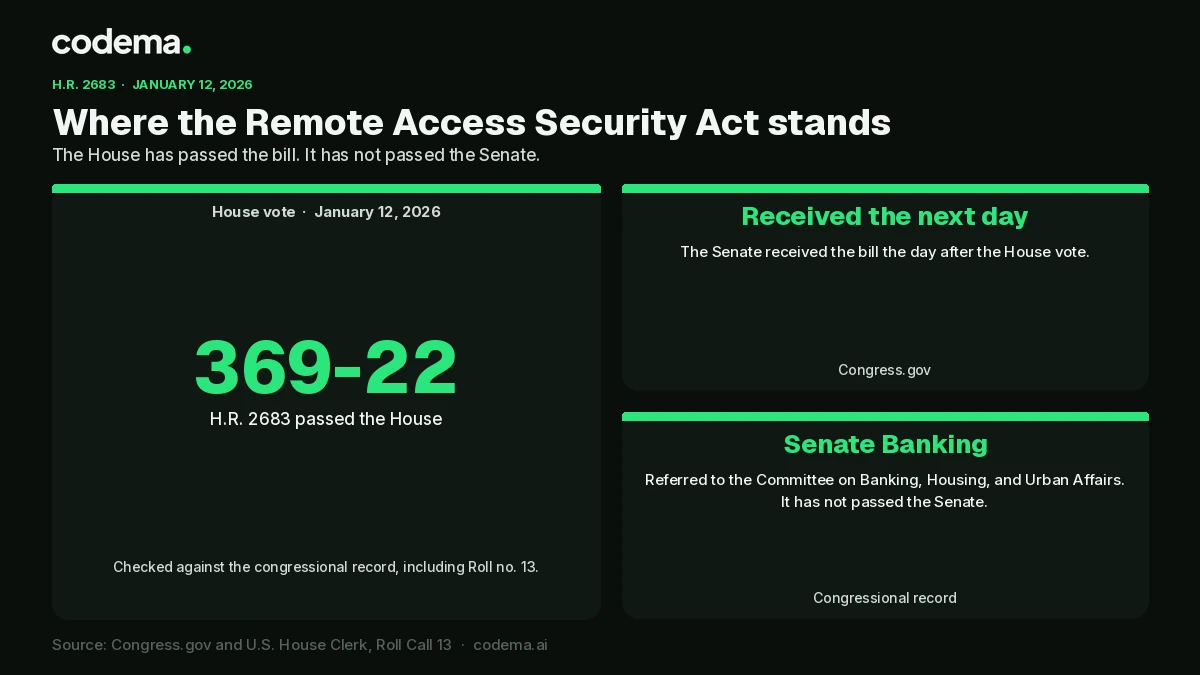
The companies fear the controversy surrounding Huang could add political momentum to the Remote Access Security Act, or RASA, a bill that would give the Commerce Department authority to regulate remote, cloud-based access to restricted technology, the people said. Reuters reported that the House passed the bill in January by a 369-22 vote and that it awaits Senate action.
We checked the congressional record. H.R. 2683, the Remote Access Security Act, passed the House on January 12, 2026, by a 369-22 vote (Roll no. 13). The Senate received it the next day and referred it to the Committee on Banking, Housing, and Urban Affairs. It has not passed the Senate. Restricting overseas cloud access, Reuters noted, would make it harder for Chinese developers to obtain high-end computing power without importing the chips directly.
The Information's reported Commerce rule
The Information reported on Wednesday evening that the Commerce Department is finalizing a long-awaited rule aimed at stopping Chinese AI firms from using advanced Nvidia chips through data centers abroad, according to Investing.com and CNBC accounts of that report. Investing.com said The Information, citing two people familiar with the matter, reported that the rule could be announced this month, that it would expand current semiconductor controls from the Bureau of Industry and Security to seven additional countries, including Malaysia, Singapore and Thailand, and that Commerce is consulting other government agencies before the rule can be finalized. We could not read the paywalled Information article itself.
Chosunbiz, also citing The Information, named the seven countries as Singapore, Malaysia, Thailand, Indonesia, Brazil, Norway and South Africa. It said that once the rules take effect, those countries would need Commerce Department approval to import Nvidia's Blackwell-class and more advanced AI chips, and that recipients would have to report who will receive the chips and how they will be used. Chosunbiz also said data centers run by U.S. companies in those countries would be exempt from licensing if they meet certain conditions, including reporting customers' countries and the scale of computing rather than allowing remote access from arms-embargoed countries. Those details are The Information's reporting as relayed by those outlets, not an official Commerce announcement.
This reported rule is separate from the Remote Access Security Act, which still awaits a Senate vote. Neither report said the rule has been issued.
How Reuters ties this to the Huang controversy
The rush is reportedly a response to political risk, not to a new official ban. Reuters said the fear is that a scandal involving Huang could add momentum to tighter remote-access rules. Huang said on Sunday that he had been unfaithful to his wife. The New York Times reported that the woman involved was a former executive at a Singapore-based cloud company, and that US authorities had concluded she was a Chinese intelligence asset, Reuters reported. Reuters could not independently verify it, and China has denied it. Our earlier article on the Nvidia board's probe of Huang covers that reporting in more detail.
The woman involved had business dealings and investment ties with several leading Chinese technology companies, including Tencent and Alibaba, according to two people familiar with the matter, Reuters reported. Tencent said its computing procurement, leasing and operations complied with applicable laws and regulations, including export controls, and that it had "no knowledge of, nor involvement in, any alleged unlawful activities referenced in these reports, nor do we have any business dealings or investment ties with the individuals concerned." Alibaba did not respond to a request for comment. Nvidia and the Commerce Department did not respond to Reuters' requests for comment.
Grey-market stockpiling
The prospect of tougher enforcement has also fueled demand for restricted Nvidia AI chips in China's grey market, prompting traders and intermediaries to start stockpiling these processors, two of the people said. They said buyers fear the controversy could prompt a broader US crackdown on smuggling of advanced chips and AI servers into China.
Reuters also pointed to other gaps in current controls. A Chinese university with deep ties to the People's Liberation Army bought Nvidia H200 chips last month despite being on a US export blacklist, it reported; we covered that as Northwestern Polytechnical University's H200 purchase. US prosecutors in March charged Super Micro Computer co-founder Yih-Shyan "Wally" Liaw and two others with conspiring to divert servers containing Nvidia chips to China through a Southeast Asia-based company. Prosecutors said the company bought about $2.5 billion of servers from Super Micro between 2024 and 2025, and that a substantial portion was diverted to China. The defendants have not been convicted.
What to watch is whether Commerce announces the reported remote-access rule, whether the Senate takes up the Remote Access Security Act, and whether Nvidia or the Commerce Department issues a public statement. If the board announces a decision on Huang, we will update the existing probe article rather than start a new one.
FAQ
Why are Chinese AI firms rushing to rent Nvidia chips overseas?
Three people familiar with the matter told Reuters that Chinese AI companies are trying to lock in Nvidia-powered computing capacity at data centers outside China. They are concerned that a controversy involving Nvidia CEO Jensen Huang could spur Washington to tighten limits on their remote use of advanced processors.
What is the remote-access loophole in US export controls?
Washington restricts exports to China of Nvidia's most advanced AI chips, but those rules target physical shipments. Chinese companies can still use the same processors remotely by renting computing power at data centers overseas, Reuters reported. Closing that gap would make it harder to get high-end compute without importing the chips.
What is the Remote Access Security Act, and where does it stand?
The bill would give the Commerce Department authority to regulate remote, cloud-based access to restricted technology, Reuters reported. We verified on Congress.gov that H.R. 2683 passed the House on January 12, 2026, by a 369-22 vote and was received in the Senate the next day. It has been referred to the Senate Banking Committee and has not passed the Senate.
How is this tied to the scandal involving Jensen Huang?
Reuters' sources said the companies fear the controversy surrounding Huang could add political momentum to the bill, not that a ban has been announced. Reuters reported that Huang said he had been unfaithful to his wife, and that the New York Times said the woman involved was a former executive at a Singapore-based cloud company and that US authorities had concluded she was a Chinese intelligence asset. Reuters could not independently verify it, and China has denied it.
Which countries would the rule cover?
The Information reported that the rule would expand Commerce Department semiconductor controls to seven additional countries, including Malaysia, Singapore and Thailand, and could be announced this month, according to Investing.com's account of that report. Chosunbiz, also citing The Information, named the seven as Singapore, Malaysia, Thailand, Indonesia, Brazil, Norway and South Africa, and said those countries would need licenses and end-user reporting for Nvidia's Blackwell-class and more advanced AI chips.
Sources
- Reuters, Exclusive: Chinese AI firms rush to secure Nvidia chip capacity as spy scandal stirs fear of US curbs (Nov. 12, 2026), via Investing.cominvesting.com
- Reuters, Exclusive: Chinese AI firms rush to secure Nvidia chip capacity as spy scandal stirs fear of US curbs (Nov. 12, 2026), via Euronextlive.euronext.com
- The Information, Commerce Department Finalizing Long-Awaited AI Remote Access Rule, by Leo Schwartz (Nov. 11, 2026)theinformation.com
- The Information via Investing.com, U.S. finalizing rule to block China's remote AI chip access (Nov. 11, 2026, 10:52 p.m.)investing.com
- The Information via Chosunbiz, US to widen AI chip export controls to seven nations, curb China remote access (Nov. 12, 2026)biz.chosun.com
- CNBC, Jensen Huang's affair with alleged spy revives push to tighten China chip curbs ahead of Trump-Xi summit, by Anniek Bao (Nov. 12, 2026)cnbc.com
- H.R. 2683, Remote Access Security Act, 119th Congresscongress.gov
- U.S. House Clerk, Roll Call 13, H.R. 2683 (Jan. 12, 2026)clerk.house.gov
Topics

John F.Hardware & Infra desk
John F. is a Codema.ai house byline: a pen name used by our editorial desk, not one individual journalist. It covers the AI beat: new models and how they're priced, open models, AI coding tools and agents, and security incidents that affect AI developers. Pieces under this name are written with AI assistance and reviewed by a human editor before they're published.
All stories by John F.

