
OpenRouter says it has off-boarded three inference providers and removed 125 endpoints from Zero Data Retention (ZDR) eligibility, after security researchers at Dragos showed that prompts sent to some AI providers were being stolen or kept against their privacy settings. OpenRouter announced the moves in a post dated Nov. 22 and said it has notified all potentially affected customers.
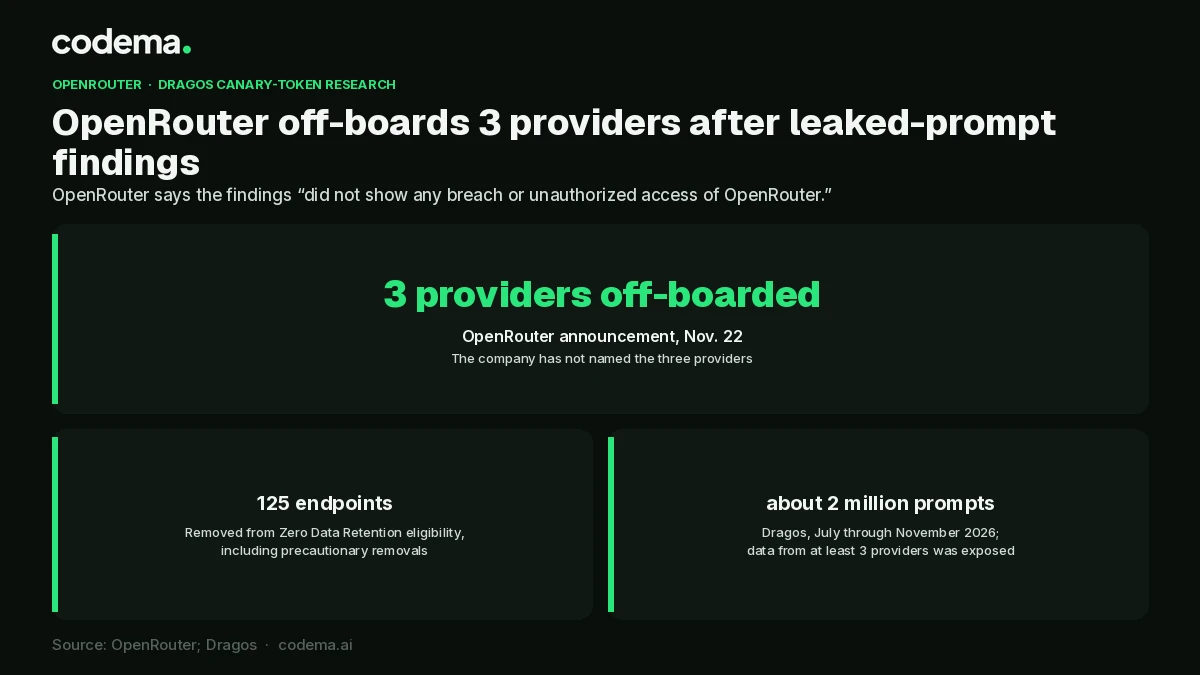
OpenRouter was clear that the problem was not its own platform. "These findings did not show any breach or unauthorized access of OpenRouter," the company wrote. The 125 endpoints include providers flagged by the researchers, plus others OpenRouter removed "as a precautionary measure."
What Dragos found
The exposure came to light through research published on Nov. 19 by HD Moore, chief research officer at Dragos. From July through November 2026, his team sent roughly two million prompts to widely used AI services, each seeded with canary tokens: unique URLs and real AWS keys tied to empty, fully logged accounts. Any later use of one of those secrets showed that someone had seen the original prompt, Dragos wrote.
Dragos reported three main findings:
- Provider compromises. Data from at least three AI hosting providers was exposed. Attackers used the stolen AWS keys to probe S3 buckets, search Secrets Manager and try to enable models in AWS Bedrock. The earliest incident dates to mid-July, and none of the three providers knew about its breach until Dragos told them, the firm said. In two of the three cases, some stolen requests were marked ZDR.
- Marketplace sellers reading prompts. On one AI inference marketplace, some resellers listed models at the lowest price, turned on request logging and then tried to use the secrets they saw, without exploiting any bug.
- Privacy settings ignored. A Chinese AI lab's systems fetched the secret URLs from more than half of the prompts Dragos sent to its models between July and October, including roughly two-thirds of those marked "no data collection" or ZDR. Prompts sent to U.S. providers reselling that lab's models triggered the same scraper.
Dragos does not name the providers involved. It says it is now working with about a dozen of them.
Who has posted notices
OpenRouter's post links to public security notices from three providers: Novita (about MiniMax requests), Phala (a preliminary incident report) and Together (about prompt leakage for requests in June and July). OpenRouter says not all affected providers have posted publicly, and it does not say which providers it off-boarded.
What OpenRouter is changing
Beyond the removals, OpenRouter says it is:
- adapting the researchers' testing approach so it can run these checks on an ongoing basis;
- verifying network paths to spot providers that forward requests and responses to third parties;
- requiring "appropriate assurances and validation" before any removed endpoint gets ZDR eligibility back.
OpenRouter said it "will keep raising the bar, and providers that want to be on OpenRouter will need to meet it."
Why it matters for builders
Routers like OpenRouter give developers one API key for many models and hosts. Dragos's point is that every hop can see the whole prompt and response, and a request can pass through more than one router before it reaches a model. Of about two thousand routes it traced, several hundred included a system it could not identify.
That matters most for AI agents, which Dragos says "will happily send whatever they can read, including credentials." Our MCP security best practices cover how to use agent tools without leaking data, and the Fireworks AI breach earlier this month showed how much customer data can sit on an inference platform.
Dragos's own advice: choose upstream providers yourself instead of a default pool, stay away from reseller marketplaces, seed your own canary credentials, and turn on secret filtering where a provider offers it. For how hosted models and providers fit together, see our AI models explained guide.
Sources
- OpenRouter: Data Processing Incidents on Inference Providers (Nov. 22, 2026)
- Dragos: Three breaches, endless leaks: Your AI supply chain needs canaries, by HD Moore (Nov. 19, 2026)
FAQ
Was OpenRouter hacked?
OpenRouter says no. Its Nov. 22 post says the findings did not show any breach or unauthorized access of OpenRouter itself. The problems were at some of the inference providers that OpenRouter routes requests to, according to OpenRouter and Dragos.
Which providers did OpenRouter remove?
OpenRouter has not named the three providers it off-boarded. It lists public security notices from Novita, Phala and Together, but says not all affected providers have posted publicly, and it does not say which of them, if any, were among the three removed.
What are canary tokens?
A canary token is a secret, such as a fake AWS key or a unique URL, that exists in only one place. If anyone ever uses it, you know that place was exposed. Dragos put unique canary tokens in each test prompt and watched where they were later used.
Does Zero Data Retention protect my prompts?
Not always. Dragos found cases where prompts marked Zero Data Retention were still stolen or kept, including in two of the three provider breaches. It also notes a privacy flag only binds the first hop, so it is worth checking which providers actually handle your requests.
What should developers using AI routers do now?
Dragos suggests picking upstream providers yourself rather than accepting a default pool, avoiding reseller marketplaces, planting your own canary credentials in agent context, turning on secret filtering and keeping real credentials out of prompts. Rotate any keys that may have been sent in prompts.
Sources
Topics

John F.AI desk
John F. is a Codema.ai house byline: a pen name used by our editorial desk, not one individual journalist. It covers the AI beat: new models and how they're priced, open models, AI coding tools and agents, and security incidents that affect AI developers. Pieces under this name are written with AI assistance and reviewed by a human editor before they're published.
All stories by John F.