Part of our AI models explained: ChatGPT, Claude, Gemini and the rest guide
OpenAI chief scientist Jakub Pachocki has published OpenAI's internal pretraining perplexity measurements in a Nov. 22 post titled "Perplexity and Intelligence". He argues that perplexity should become a metric to compare AI developers and to set shared safety standards, including common limits that labs would agree not to cross until monitoring of AI behavior improves.
Here, perplexity is a training metric, not Perplexity the search company. It "measures how well a model predicts the next token on average; lower perplexity means better predictions," Pachocki writes. OpenAI tracks its log, also called cross-entropy loss.
OpenAI's pretraining numbers
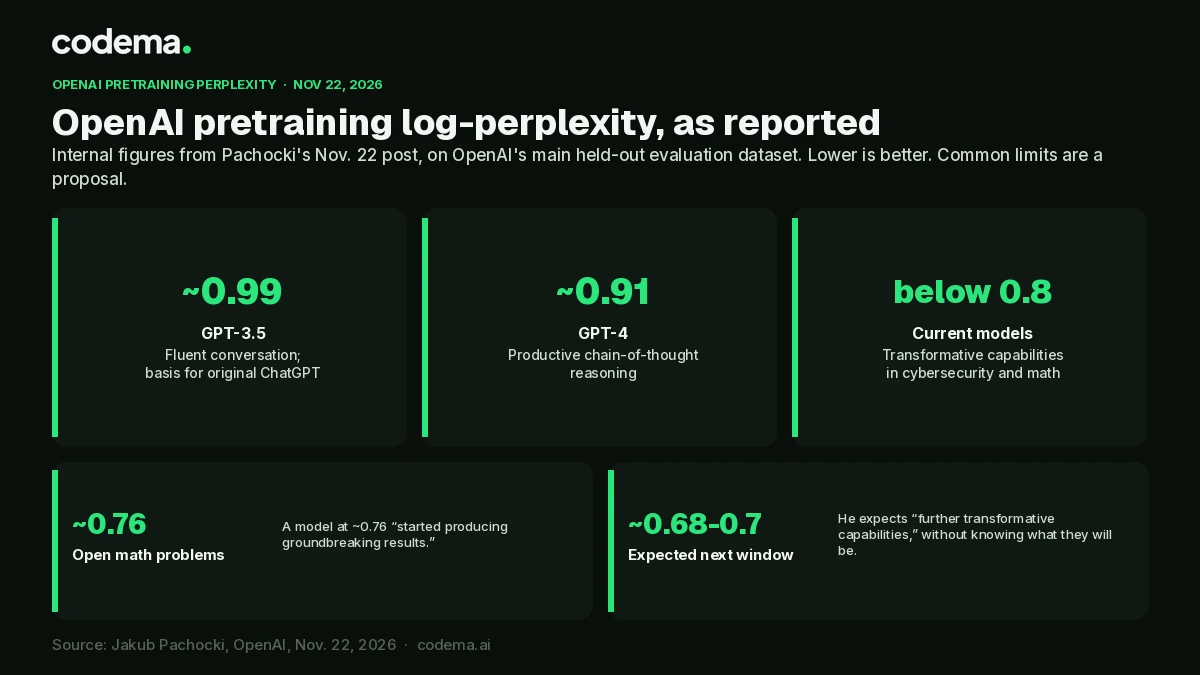
The figures are log-perplexity on OpenAI's main held-out evaluation dataset, which a footnote says is "sourced from our internal codebase" (for a fixed snapshot). Pachocki ties each level to new capabilities:
- GPT-3.5, ~0.99: "capable of fluent conversation and formed the basis for the original ChatGPT."
- GPT-4, ~0.91: "proficient at utilizing chain-of-thought reasoning productively," which led to modern reasoning models.
- Below 0.8 (current models): "the emergence of transformative capabilities in fields like cybersecurity and mathematics."
He adds that once OpenAI upgraded to a model of log-perplexity ~0.76, it "started producing groundbreaking results" on open math problems. He stresses it "was not at all clear a priori" that these capabilities would appear at those thresholds. Extrapolating, he expects "further transformative capabilities as we enter the ~0.68-0.7 log-perplexity window," without knowing what they will be.
A footnote says OpenAI's loss curve shows "a steep acceleration in 2026," which OpenAI attributes "mostly to the outcomes of long term research and compute investments, and only in a smaller part to automation."
Pachocki says publishing the numbers "gives competitors a clearer picture of where we stand," but that the concern is outweighed by the urgency of shared safety measures.
What he proposes
Pachocki frames these as proposals:
- Perplexity as a cross-lab metric for general intelligence, regardless of how automated AI development becomes.
- Shared norms among frontier developers for evaluating such models and red-teaming their safety cases by the time they are first used, including shared transparency standards.
- Common limits, "based on perplexity and other measurements, that developers are committed to not crossing until our ability to understand and monitor AI behavior achieves a certain concrete milestone (such as the development of a successor to CoT monitors)."
He wants "an industry standard that specifies a first limit on development," plus what labs would need to achieve before going past it. The post does not say any other lab has agreed.
His concern is AI speeding up its own pretraining research. He writes that "as soon as 2027 we could conceivably see a similar avalanche of fundamental pretraining advancements," and that progress on alignment and monitoring is "unlikely to be fast enough" to keep up. He also expects "further degradation" in today's alignment auditing. That echoes OpenAI researchers' recent finding that chain-of-thought monitoring is getting harder, and METR's estimate that AI task length doubles about every 3.6 months.
The weak spots he lists
Pachocki names four challenges with perplexity as a shared metric:
- Comparison across labs: different evaluation datasets and training data mixes.
- Detachment from actionable evaluations: perplexity is not itself a task anyone cares about.
- Advances outside pretraining: chain-of-thought reasoning boosts capabilities without lowering perplexity.
- Unknown floor: no one knows the data's inherent entropy, so gains will look smaller even as they matter more.
For background on how pretraining fits with fine-tuning and reasoning, see our AI models explained guide, and for more coverage, our AI hub.
Sources
- OpenAI: Perplexity and Intelligence, by Jakub Pachocki (Nov. 22, 2026)
FAQ
What does perplexity mean here?
In this post, perplexity is a training metric, not Perplexity the AI search company. It measures how well a model predicts the next token on held-out data; lower is better. OpenAI tracks its log, also called cross-entropy loss, during pretraining.
What numbers did OpenAI share?
Pachocki wrote that GPT-3.5 had a log-perplexity of ~0.99 on OpenAI's current main evaluation dataset, GPT-4 ~0.91, and that OpenAI has now reached losses below 0.8. He said a model of ~0.76 started producing groundbreaking results on open math problems. The dataset comes from OpenAI's internal codebase, for a fixed snapshot.
What limits is Pachocki proposing?
He proposes common limits, based on perplexity and other measurements, that developers commit not to cross until the ability to understand and monitor AI behavior reaches a concrete milestone, such as a successor to chain-of-thought monitors. It is a proposal in a blog post, not an agreement any lab has signed.
Can other labs' perplexity be compared with OpenAI's?
Not directly yet. Pachocki lists this as a challenge: developers use different evaluation datasets and train on different data mixes. He says that with a goal of transparency, labs could find transferable ways to compare base models.
Sources
Topics
Kelly B.AI desk
Kelly B. is a Codema.ai house byline: a pen name used by our editorial desk, not one individual journalist. It covers Hardware & Infra: GPUs and the memory inside them (HBM, GDDR7, DDR5, NAND), hardware for running AI locally, GPU rental prices, chipmaking, and the data centres and power behind AI. Pieces under this name are written with AI assistance and reviewed by a human editor before they're published.
All stories by Kelly B.