

Part of our AI models explained: ChatGPT, Claude, Gemini and the rest guide
OpenAI's third-quarter 2026 revenue rose nearly 50% from the second quarter to $10 billion, and the company is running at a roughly $50 billion annual pace, CFO Sarah Friar told Yahoo Finance's Deirdre Bosa on November 10. Those are Friar's on-the-record figures, not audited financial statements, and they are the first time OpenAI has described a $10 billion quarter.
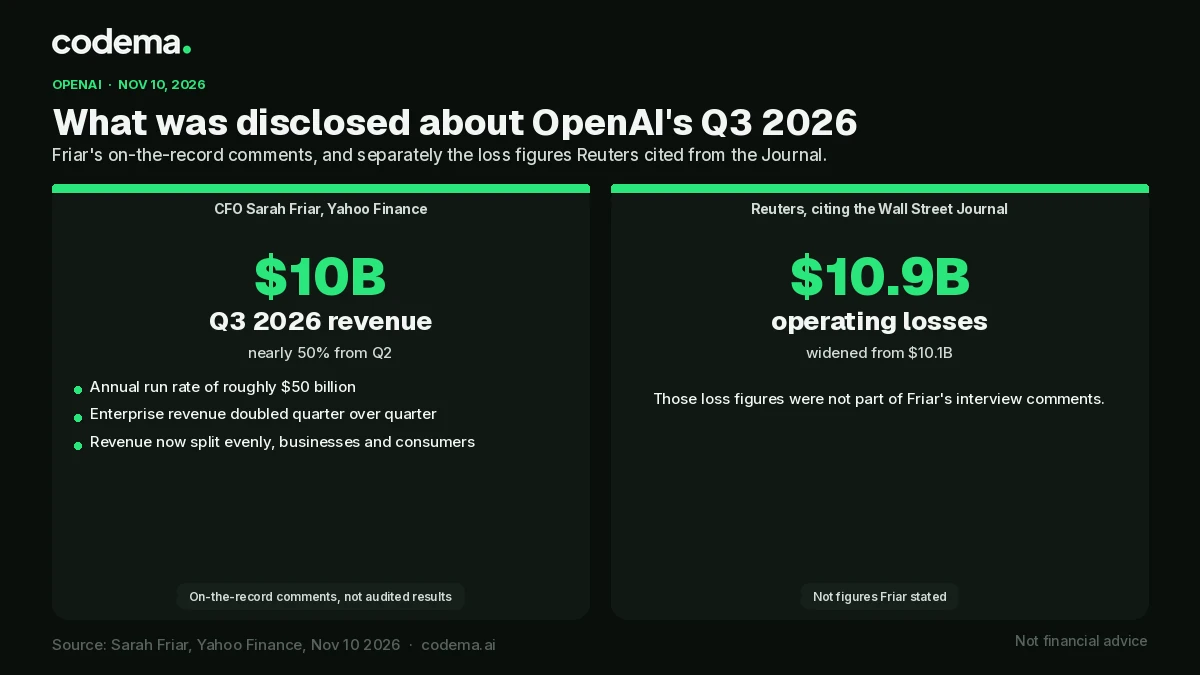
Friar said the growth was driven by frontier research and the enterprise business. "Our enterprise business doubled quarter over quarter," she said, adding that revenue is now split evenly between enterprise and consumer. She pointed to products such as Coding and Cyber, and to getting more virtual assistants like Dots into the enterprise; Yahoo Finance described Dots as OpenAI's AI agent platform for enterprise. Friar also said the small- and medium-business offering grew more in the third quarter than in the prior six quarters, that consumer sales improved 20% quarter over quarter, that subscriptions topped 100 million users, and that the company has 1.2 billion weekly active users. Yahoo Finance noted that the nearly 50% quarterly jump was better than the 18% growth OpenAI saw in the second quarter, according to the Wall Street Journal.
A run rate is a recent revenue pace scaled up to a full year. It describes how fast Friar says OpenAI is booking revenue now, not how much it has already earned in 2026, and it can move if later quarters are faster or slower. Friar did not spell out the exact window behind the roughly $50 billion figure, so it should be read as a company-described pace, not as a GAAP annual result. The consumer and enterprise products sitting under that number are the same ChatGPT-family services we cover in our guide to AI models.
The revenue print is only half of the picture investors are watching this week. Reuters, citing the Wall Street Journal, reported that operating losses widened to $10.9 billion from $10.1 billion in the prior quarter, even as revenue rose. The same Reuters account said OpenAI told investors its adjusted operating margin improved to -109% from -150%, according to documents viewed by the Journal, and that OpenAI did not immediately respond to a Reuters request for comment. Those loss and margin figures were not part of Friar's interview remarks and should not be read as numbers she stated on Yahoo Finance.
The disclosure lands in the same week Anthropic started the roadshow for its IPO. Anthropic's amended S-1 reported $17.0 billion of revenue for the quarter ended September 30, 2026, up from $11.6 billion in the June quarter, and $33.2 billion for the first nine months of the year. Those are audited-style figures in a registration statement, not a direct like-for-like with Friar's $10 billion comment. Anthropic has also set a $70 to $78 IPO price range and applied to list on Nasdaq as ANT. In the Yahoo Finance interview, Friar said Anthropic's enterprise success had shown her the value of distribution agreements with third-party cloud providers, and that unlocking OpenAI's Microsoft Azure contract could be "a very big tailwind in 2027."
Codema's AI Money hub is following both companies' figures this week, alongside other third-quarter prints such as CoreWeave's $3.661 billion Q3 revenue. What to watch is whether OpenAI later publishes a fuller breakdown that can be checked against Friar's $10 billion quarter and roughly $50 billion run rate, and whether the Journal's loss figures, which Reuters reported from documents shown to investors, are confirmed in a formal release.
FAQ
What was OpenAI's Q3 2026 revenue?
CFO Sarah Friar told Yahoo Finance's Deirdre Bosa on November 10 that third-quarter revenue rose nearly 50% from the second quarter to $10 billion, with an annual run rate of roughly $50 billion. Those are Friar's on-the-record figures, not audited financial statements.
What did Sarah Friar say about enterprise and consumer revenue?
Friar said the enterprise business doubled quarter over quarter and that revenue is now split evenly between enterprise and consumer. She also said consumer sales improved 20% quarter over quarter, subscriptions topped 100 million users, and the company has 1.2 billion weekly active users.
Did the Wall Street Journal report an OpenAI operating loss?
Yes. Reuters, citing the Wall Street Journal, reported that operating losses widened to $10.9 billion from $10.1 billion in the prior quarter. The same Reuters account said documents viewed by the Journal showed the adjusted operating margin improved to -109% from -150%. Those loss figures were not part of Friar's interview comments.
Is the $50 billion run rate the same as 2026 revenue?
No. Friar described an annual run rate of roughly $50 billion, which is a recent revenue pace scaled to a full year, not a reported full-year total and not an audited result. She did not spell out the exact window used to annualize that figure.
How do OpenAI's figures compare with Anthropic's?
They are different kinds of disclosure. Anthropic's amended S-1 reported $17.0 billion of revenue for the quarter ended September 30, 2026, and $33.2 billion for the first nine months of the year. OpenAI's $10 billion quarter and roughly $50 billion run rate are Friar's on-the-record comments, not figures from a public filing.
Sources
Topics

Carrie F.AI Money desk
Carrie F. is a Codema.ai house byline: a pen name used by our editorial desk, not one individual journalist. It covers AI Money: earnings from Big Tech and chipmakers, AI capital spending and how the build-out is financed, plus plain-English explainers such as free cash flow, EPS and how to read a 10-Q. It's news and analysis, not financial advice. Pieces under this name are written with AI assistance and reviewed by a human editor before they're published.
All stories by Carrie F.