Part of our AI chips and memory explained: GPUs, TPUs and HBM guide
In this article
- 1. Teleoperation: a human drives, the robot records
- 2. Imitation learning: turning demos into a policy
- 3. Reinforcement learning in simulation, then sim-to-real
- 4. Synthetic data and world models
- 5. Vision-language-action models: pretrain broadly, fine-tune per task
- Training methods compared
- What the demo hours cost: our math
- Sources
A humanoid robot that folds laundry or stocks a shelf is not programmed line by line. It is trained, mostly by copying people. Engineers drive the robot remotely to show it a task, record everything it sees and does, and train a neural network to reproduce it. Walking and balance usually come from a different source: millions of practice falls in a physics simulator. The newest systems put a large pretrained vision-language model on top, so a robot can follow an instruction it was never shown.
Here is how each method works, how much data the published systems used, and what the data costs.
1. Teleoperation: a human drives, the robot records
In teleoperation, a person controls the robot in real time while the system logs camera frames, joint positions and the commands sent. NVIDIA's GR00T workflow documentation calls it "the most common way to collect this task data." The common rigs:
- VR or XR headsets. The operator's head and hand movements are tracked and mapped onto the robot. NVIDIA lists the PICO 4 Ultra, Meta Quest 3 and Apple Vision Pro as suitable devices.
- Leader-follower arms. The operator physically moves a small "leader" arm and the robot's "follower" arm mirrors it. Stanford's open-source ALOHA rig works this way, and its authors say the whole two-arm system costs under $20,000. Mobile ALOHA adds a wheeled base for whole-body teleoperation on a $32,000 budget.
- Gamepads and keyboards for simple tasks. NVIDIA notes they offer limited degrees of freedom for dexterous work.
- Full-body motion capture or exoskeleton-style suits, used by some labs to drive legs and torso as well as arms.
Because human and robot limbs differ, every rig needs a retargeting step that converts human motion into joint commands the robot can actually execute. Quality matters more than volume: NVIDIA's data collection guide tells operators to discard failed attempts, avoid jerky motion and collect at least 200 clean successful demonstrations for its sample pick-and-place task.
2. Imitation learning: turning demos into a policy
The recordings train a policy, a network that maps what the robot sees to what it should do next. This is supervised learning, often called behaviour cloning. The ALOHA team's Action Chunking with Transformers (ACT) method predicts short sequences of actions rather than one step at a time, which reduces compounding errors. With it, the low-cost rig learned six fine tasks, such as slotting a battery, at 80% to 90% success from about 10 minutes of demonstrations per task. Mobile ALOHA reached complex tasks like cooking shrimp with about 50 demonstrations per task, helped by co-training on older static ALOHA data.
The weakness is scale: every new task, object or robot body needs more human hours.
3. Reinforcement learning in simulation, then sim-to-real
For locomotion, many labs skip demonstrations and let the robot learn by trial and error in a simulator, rewarded for staying upright and moving as told. GPUs make this fast. In a widely cited ETH Zurich study, thousands of simulated ANYmal quadrupeds trained in parallel on a single workstation GPU learned to walk on flat terrain in under four minutes and on uneven terrain in about 20 minutes, and the policies transferred to the real robot.
Humanoids use the same recipe. ROBOTIS reports training 4,096 copies of its K1 humanoid in parallel in NVIDIA Isaac Lab to track a dance motion, about four hours of wall-clock time. The hard part is the sim-to-real gap: simulated friction, mass and motor behaviour never match reality exactly. The standard fix is domain randomization, which varies those parameters during training so the policy works across them.
4. Synthetic data and world models
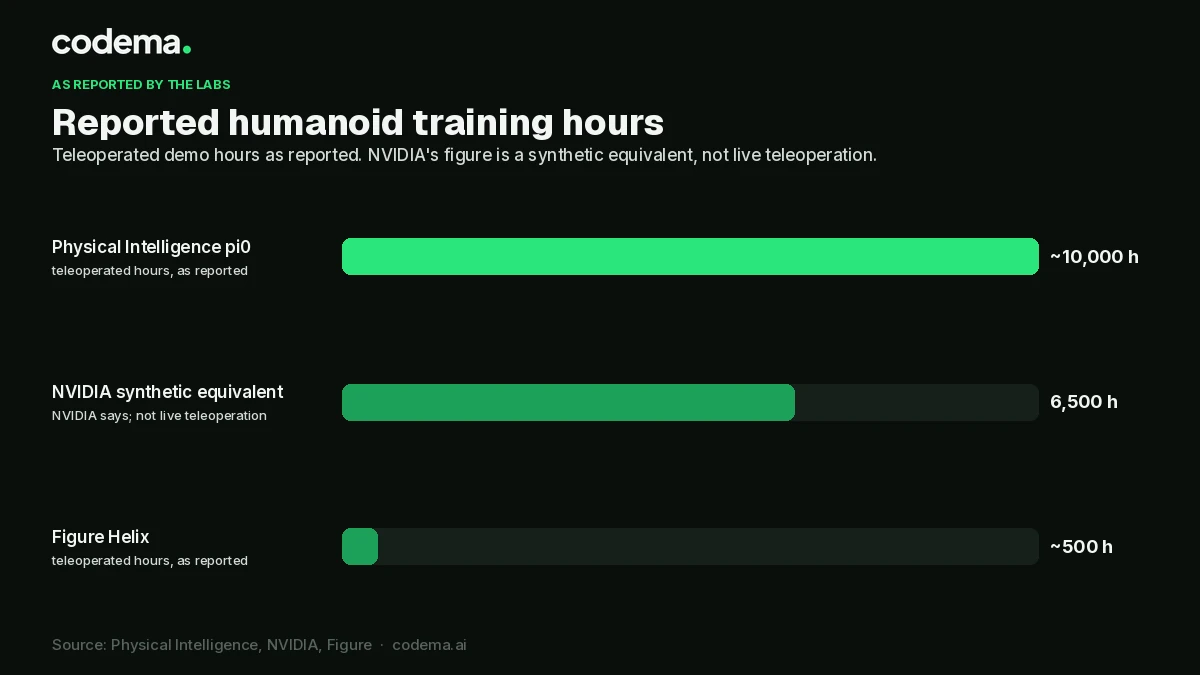
Real demonstrations are, as NVIDIA's GR00T N1 announcement puts it, "limited by a person's 24-hour day." So labs multiply them. NVIDIA says its GR00T blueprint, built on Omniverse and its Cosmos Transfer world foundation models, generated 780,000 synthetic trajectories, equal to 6,500 hours or about nine months of human demonstrations, in 11 hours, from a small number of real demos. Combining that with real data improved GR00T N1's performance by 40% over real data alone, according to NVIDIA. The GR00T N1 paper says the model trains on a mix of real-robot trajectories, human videos and synthetic data.
5. Vision-language-action models: pretrain broadly, fine-tune per task
A vision-language-action (VLA) model takes camera images, a text instruction and the robot's joint state, and outputs motor commands. It usually starts from a vision-language model pretrained on internet data, then trains on robot data. Four systems and the data they disclosed:
- Physical Intelligence pi0. Pre-trained on about 10,000 hours of robot demonstrations, which the company says it collected across 8 distinct robots, plus the open-source Open X-Embodiment dataset (22 robots from 21 institutions). It outputs actions up to 50 times a second. Hard tasks like laundry folding still get task-specific fine-tuning. (paper, blog)
- Figure Helix. About 500 hours of teleoperated data from multiple robots and operators. Figure says that is under 5% of the size of previously collected VLA datasets. A 7-billion-parameter "System 2" model reasons; an 80-million-parameter "System 1" outputs 35-degree-of-freedom upper-body control at 200 Hz. A separate VLM auto-labels clips with instructions. (Figure)
- Google DeepMind Gemini Robotics. Built on Gemini 2.0 and trained on a teleoperated dataset collected on a fleet of ALOHA 2 robots over 12 months, "thousands of hours" of expert demonstrations. DeepMind says it can learn new short tasks from as few as 100 demonstrations. (paper) Its successor is behind the Mercedes-Benz kitting pilot in our Gemini Robotics 2.5 report.
- NVIDIA GR00T N1. An open humanoid model with the same fast/slow two-system design, trained on real, human-video and synthetic data as above.
Training methods compared
| Method | Main data | Data cost | Speed to a working skill | Strength | Weakness |
|---|---|---|---|---|---|
| Teleoperation + imitation learning | Human-driven demos on the real robot | High: operator time plus a rig per operator | Minutes to hours of demos per task | Learns real dexterous skills directly | Scales with human hours; new task, new data |
| Reinforcement learning in simulation | Simulated trial and error | Low marginal cost; GPU time | Minutes to hours of GPU training | Locomotion and balance, robust to pushes | Sim-to-real gap; reward design is hard for hand tasks |
| Synthetic augmentation | Simulated variations of a few real demos | Low per trajectory once set up | 780,000 trajectories in 11 hours (NVIDIA) | Multiplies scarce real data | Still needs real seed demos; simulation fidelity limits |
| Human video and world-model pretraining | Videos of people, generated scenes | Low collection cost | Long pretraining runs | Broad knowledge of objects and motion | No direct robot actions; must be mapped to a body |
| VLA foundation model + fine-tuning | Web pretraining + hundreds to ~10,000 robot hours | Highest upfront | Fast per new task once pretrained | Follows language, handles unseen objects | Large data and compute; latency on cloud models |
Sources for the figures: NVIDIA, ALOHA, ETH Zurich, Figure, Physical Intelligence and DeepMind, as linked above.
What the demo hours cost: our math
Labs rarely publish collection budgets, so here is a simple estimate. These are our assumptions, not company figures: an operator costs $30 an hour, fully loaded, and each hour of usable recording takes 1.5 operator hours once resets, failed takes and breaks are counted.
| Dataset size | Example | Operator hours | Labour cost |
|---|---|---|---|
| 500 hours | Figure Helix | 750 | $22,500 |
| 10,000 hours | pi0 pre-training | 15,000 | $450,000 |
By the same assumptions, 10,000 hours is about 7.5 operator-years at 2,000 working hours a year. Hardware is extra: at ALOHA's under-$20,000 price, a fleet of 20 rigs is up to $400,000 before any humanoid is bought.
Real-world collection is slower than the hours suggest. DROID, a large open dataset, gathered 350 hours of interaction data with 50 collectors over 12 months, which is 7 recorded hours per collector across the year, by our math. That gap between paid time and usable data is why NVIDIA's synthetic multiplier and pretrained VLA models matter: they cut how many human hours each new skill needs.
For the model side of this story, see our AI models explained guide. For robotics funding, see Agile Robots' $500M raise, and for how self-driving systems are regulated once trained, robotaxis in the US. The chips these models train on are covered in our AI chips and memory guide.
Sources
- NVIDIA: GR00T end-to-end workflow, concepts, teleoperation data collection guide, GR00T N1 announcement (Mar. 18, 2025) and GR00T N1 paper
- Figure: Helix (Feb. 20, 2025)
- Physical Intelligence: pi0 paper and blog (Oct. 31, 2024)
- Google DeepMind: Gemini Robotics paper
- Stanford: ALOHA and Mobile ALOHA
- DROID dataset, Open X-Embodiment, Learning to Walk in Minutes and ROBOTIS on Isaac Lab training
FAQ
What is robot teleoperation?
A person controls the robot remotely, through a VR headset, a leader arm the robot copies, or a joystick, while the system records camera images, joint positions and the commands sent. Those recordings become training examples. NVIDIA's GR00T documentation calls teleoperation the most common way to collect task data for humanoids.
How many hours of demonstrations does a robot model need?
It varies widely. ALOHA learned single tasks from about 10 minutes of demonstrations. Figure says Helix used about 500 hours of teleoperated data. Physical Intelligence pre-trained pi0 on about 10,000 hours of robot demonstrations plus the open-source Open X-Embodiment data.
Why train robots in simulation?
Simulation runs thousands of virtual robots in parallel and never breaks hardware. In one study, a simulated ANYmal quadruped learned to walk on flat terrain in under four minutes on one workstation GPU. The catch is the sim-to-real gap, so labs randomize physics during training.
What is a vision-language-action model?
A VLA model takes camera images, a text instruction and the robot's own joint state, and outputs motor commands. Examples include Google DeepMind's Gemini Robotics, NVIDIA's GR00T N1, Figure's Helix and Physical Intelligence's pi0. Most start from a vision-language model pretrained on internet data.
Can synthetic data replace human demonstrations?
Not fully, so far. NVIDIA generated 780,000 synthetic trajectories, which it says equal 6,500 hours of human demonstrations, in 11 hours from a small set of real demos. It says mixing that with real data improved GR00T N1 by 40% over real data alone.
Sources
- NVIDIA, How to Develop and Deploy Humanoid Robots End-to-End with Isaac GR00T and Unitree G1: Concepts overviewdocs.nvidia.com
- NVIDIA, Teleoperation data collection guide (GR00T end-to-end workflow)docs.nvidia.com
- NVIDIA Newsroom, NVIDIA Announces Isaac GR00T N1 (Mar. 18, 2025)nvidianews.nvidia.com
- NVIDIA et al., GR00T N1: An Open Foundation Model for Generalist Humanoid Robots (arXiv 2503.14734)arxiv.org
- Figure, Helix: A Vision-Language-Action Model for Generalist Humanoid Control (Feb. 20, 2025)figure.ai
- Physical Intelligence, pi0: A Vision-Language-Action Flow Model for General Robot Control (arXiv 2410.24164)arxiv.org
- Physical Intelligence, Our First Generalist Policy (pi0 blog, Oct. 31, 2024)physicalintelligence.company
- Google DeepMind, Gemini Robotics: Bringing AI into the Physical World (arXiv 2503.20020)arxiv.org
- Zhao et al., Learning Fine-Grained Bimanual Manipulation with Low-Cost Hardware (ALOHA, arXiv 2304.13705)arxiv.org
- Fu, Zhao and Finn, Mobile ALOHA: Learning Bimanual Mobile Manipulation with Low-Cost Whole-Body Teleoperation (arXiv 2401.02117)arxiv.org
- Khazatsky et al., DROID: A Large-Scale In-The-Wild Robot Manipulation Dataset (arXiv 2403.12945)arxiv.org
- Open X-Embodiment Collaboration, Open X-Embodiment: Robotic Learning Datasets and RT-X Models (arXiv 2310.08864)arxiv.org
- Rudin et al., Learning to Walk in Minutes Using Massively Parallel Deep Reinforcement Learning (arXiv 2109.11978)arxiv.org
- ROBOTIS, Building Humanoid Skills with the NVIDIA Software Stackdocs.robotis.com
Topics
Derrick K.AI desk
Derrick K. is a Codema.ai house byline: a pen name used by our editorial desk, not one individual journalist. It covers Build: hands-on guides for coding agents like Claude Code, Codex and OpenCode, LLM API pricing, rate limits and prompt caching, evals and prompt injection, and running open models locally. Pieces under this name are written with AI assistance and reviewed by a human editor before they're published.
All stories by Derrick K.