

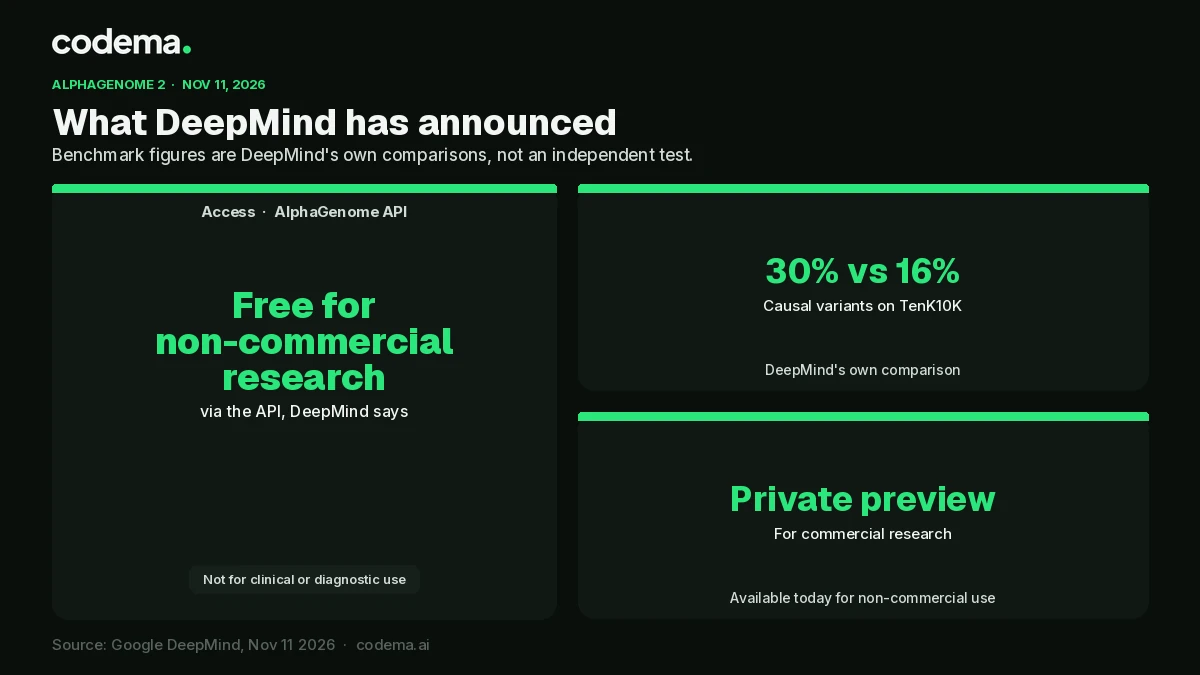
Google DeepMind said on November 11, 2026 that it is launching AlphaGenome 2, a next-generation DNA sequence model that predicts how DNA sequences and their variations affect specific human cell types. The company says the model is available today free for non-commercial research via the AlphaGenome API, and in private preview for commercial research. The same post warns that AlphaGenome and AlphaGenome 2 "are intended for research use only and have not been validated or approved for clinical or diagnostic purposes."
In a same-day post on X, the lab described the model as zooming in on specific cells to help scientists understand what drives disease, because a single-letter DNA change can affect some cells while sparing others.
What changed from the first AlphaGenome
The first AlphaGenome model, DeepMind says, took a million-letter DNA sequence and predicted properties across many tissues at once. AlphaGenome 2 is a conditional model: it takes a target biological condition, a tissue, cell type or state, alongside that sequence, and predicts effects for one condition at a time. The company says this lets it capture differences between closely related cell types and impute missing experimental readouts, such as chromatin accessibility, from a single measurement like gene activity.
DeepMind says AlphaGenome 2 was trained on more than 100 million individual cell profiles across 68 tissues, and, in a later passage of the same post, on over 107 million individual cell profiles from human and mouse bulk and single-cell data. It predicts the same core readouts as the original model, including gene expression, histone modifications and chromatin accessibility, and adds DNA methylation.
On the TenK10K dataset of 28 primary immune cell types, the lab reports that AlphaGenome 2 identified nearly twice as many causal variants (30% versus 16%) and directional gene effects (43% versus 23%) as the original AlphaGenome fine-tuned on single-cell data and other specialized tools. Those figures are DeepMind's own comparisons. The post also says scientists can upload a single-cell RNA-seq snapshot from as few as a few dozen cells to condition the model on new, unseen states without retraining.
Codema's AI coverage and research hub follow how labs put models like this into scientific work. What to watch is whether independent groups can reproduce the reported lift in variant recall, and that the model is not, on DeepMind's own terms, a clinical or diagnostic tool.
FAQ
What is AlphaGenome 2?
It is Google DeepMind's next-generation DNA sequence model. The company says it predicts how DNA sequences and their variations affect specific human cell types and cell states, rather than only broad tissue averages.
Is AlphaGenome 2 free for non-commercial research?
Yes. DeepMind says AlphaGenome 2 is available today for non-commercial research via the AlphaGenome API, and the API page states that access is free for non-commercial use. Commercial research is in private preview. The models are for research use only and have not been validated or approved for clinical or diagnostic purposes.
How is AlphaGenome 2 different from the first AlphaGenome?
DeepMind says it redesigned the model as a conditional system that predicts effects for one tissue, cell type or state at a time, instead of predicting many tissues in parallel. It reports that the new model identified nearly twice as many causal variants that change gene expression in cells (30% versus 16% on the TenK10K immune-cell dataset) as the original model fine-tuned on single-cell data.
What data was AlphaGenome 2 trained on?
DeepMind says it was trained on more than 100 million individual cell profiles across 68 tissues, and elsewhere in the same post gives a figure of over 107 million individual cell profiles from human and mouse bulk and single-cell data. It also predicts DNA methylation, which the first model did not.
Can scientists use it on new cell types without retraining?
DeepMind says yes: researchers can upload a small single-cell RNA-seq snapshot, which the model compresses into a cell-state representation, and then predict variant effects in states the model has not seen, without retraining.
Sources
- Adam Gayoso, Natasha Latysheva, Pushmeet Kohli and Ziga Avsec, AlphaGenome 2: Deciphering how cells read DNA to better understand disease (Google DeepMind, Nov. 11, 2026)deepmind.google
- Google DeepMind, AlphaGenome API (accessed Nov. 11, 2026)deepmind.google.com
- Google DeepMind, AlphaGenome 2 announcement (X, Nov. 11, 2026)x.com
Topics
Kelly B.AI desk
Kelly B. is a Codema.ai house byline: a pen name used by our editorial desk, not one individual journalist. It covers Hardware & Infra: GPUs and the memory inside them (HBM, GDDR7, DDR5, NAND), hardware for running AI locally, GPU rental prices, chipmaking, and the data centres and power behind AI. Pieces under this name are written with AI assistance and reviewed by a human editor before they're published.
All stories by Kelly B.

