
Part of our AI models explained: ChatGPT, Claude, Gemini and the rest guide
In this article
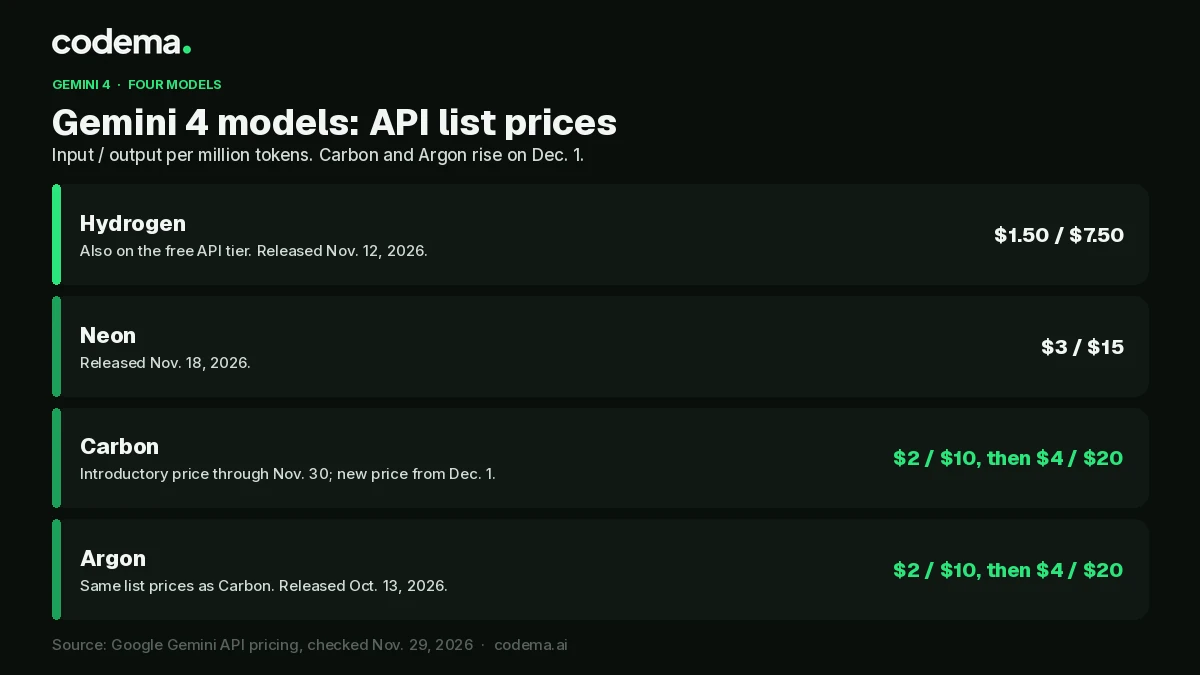
Gemini 4 is four models, not one: Hydrogen for speed, Neon for most hard work, Carbon for the hardest long jobs, and Argon, the first of the family, now an API-only reasoning model. This page links each one to our full coverage and compares them on price, access and benchmarks.
| Model | What Google built it for | API price per 1M tokens (input / output) | Cached input | Gemini app | Released | Our coverage |
|---|---|---|---|---|---|---|
| Hydrogen | Fast, efficient everyday coding and agent work | $1.50 / $7.50 (also on the free tier) | $0.075 | All plans | Nov. 12, 2026 | Gemini 4 Hydrogen: price, speed and benchmarks |
| Neon | Complex software engineering, knowledge work and science, when someone is waiting on the answer | $3 / $15 | $0.15 | AI Pro and Ultra | Nov. 18, 2026 | Gemini 4 Neon: price, benchmarks and Argon swap |
| Carbon | The hardest long-horizon tasks, deep verification and cyber defense | $2 / $10 through Nov. 30, then $4 / $20 | $0.10, then $0.20 | AI Ultra | Announced Oct. 28; public Nov. 10 | Cyber defenders first, then now available at $2 and $10 |
| Argon | Efficient frontier reasoning, with faster replies and lower token spend per turn than Carbon | $2 / $10 through Nov. 30, then $4 / $20 | $0.10, then $0.20 | No longer in the picker (replaced by Neon) | Oct. 13, 2026 | Gemini 4 Argon for builders |
Prices are Google's standard paid-tier rates from the Gemini API pricing page, checked Nov. 29, 2026. App access is from Google's Gemini Apps help page. Neon, Carbon and Argon are paid-tier only in the API.
Update, Nov. 29: Google DeepMind chief Koray Kavukcuoglu told the Financial Times that advances in recursive self-improvement, meaning AI systems helping to improve AI, drove the lab's recent leap in capability and its faster pace of Gemini releases. That is his claim, and reports on the interview say he gave no figure for how much it contributed. He also said Google would never completely give up human oversight. Ten days earlier, on Google DeepMind's podcast, he said agents control part of the compute used to run experiments for the next Gemini, but that the lab is still far from full recursive self-improvement, as The Decoder reported. He told the FT that Neon has set daily usage records in Google Antigravity and the Gemini app, without sharing numbers.
Which Gemini 4 model should you use?
Google's model guide for developers gives a clear order:
- Hydrogen for interactive web apps, routine code edits, document pipelines and parallel worker subagents. In the Gemini app, Auto picks Hydrogen or a lighter model for each prompt, Google says.
- Neon for multi-file refactoring, repository-wide debugging and analysis where a developer or coding agent is waiting. Google says it reasons more deeply than Hydrogen and finishes faster, with fewer output tokens, than Carbon.
- Carbon for multi-hour background runs, deep research, formal proofs and security audits, or when Neon at high or xhigh thinking gets stuck.
- Argon sits beside Carbon in Google's pricing as an efficient reasoning model, but Google's current model guide no longer lists it among its picks. New projects will usually start on Hydrogen or Neon.
Gemini 4 prices compared: our math
Per-token prices only tell part of the story, since a model that uses fewer tokens per task can cost less overall. Still, the ratios are simple. Neon costs exactly 2 times Hydrogen per token. From Dec. 1, Carbon and Argon cost 2.67 times Hydrogen and 1.33 times Neon, so Neon is 25% cheaper per token than either. Until Nov. 30, Carbon and Argon are a third cheaper than Neon.
To make that concrete, here is what a sample monthly workload of 50 million input tokens and 5 million output tokens would cost at Google's list prices, with and without caching. "80% cached" assumes 80% of input tokens are billed at the cached rate, which is 95% off for all four models.
| Model | Blended price per 1M tokens (3 input : 1 output) | 50M in + 5M out | Same, 80% of input cached |
|---|---|---|---|
| Hydrogen | $3.00 | $112.50 | $55.50 |
| Neon | $6.00 | $225.00 | $111.00 |
| Carbon or Argon, through Nov. 30 | $4.00 | $150.00 | $74.00 |
| Carbon or Argon, from Dec. 1 | $8.00 | $300.00 | $148.00 |
Our calculation from Google's standard paid-tier prices; it excludes search grounding fees, taxes and any discounts. Output prices include thinking tokens, so higher thinking levels raise the output bill. The Dec. 1 change doubles Carbon and Argon. If you are running either on the introductory rate, re-test Neon before the switch.
Benchmarks: Artificial Analysis, checked Nov. 29
These are third-party scores from the Artificial Analysis Google models table, not Google's own claims.
| Model (thinking level) | Intelligence Index | Time per index task | Output speed |
|---|---|---|---|
| Neon (xhigh) | 62 | 25.1 min | 94 tokens/s |
| Neon (high, default) | 60 | 15.5 min | 97 tokens/s |
| Carbon (high) | 60 | 37.6 min | 54 tokens/s |
| Carbon (medium, default) | 58 | 28.3 min | 61 tokens/s |
| Hydrogen (xhigh) | 54 | 14.5 min | 177 tokens/s |
| Hydrogen (high, default) | 51 | 8.1 min | 175 tokens/s |
| Argon (high) | 51 | 25.2 min | 77 tokens/s |
Our read: on this index, Neon at its default setting matches Carbon at high, 60 to 60, in 59% less time per task (15.5 vs. 37.6 minutes, our math). Hydrogen at high ties Argon at high on score, at about a third of the time. Scores change as Artificial Analysis re-runs models; when our launch stories went up, Argon was at 50 and Neon at 61. Google's own benchmark claims for each model are covered, and labeled as Google's, on the individual pages linked above.
Context, output and thinking levels
All four models take a 1 million-token context window and text, image, audio, video and PDF input, and Google lists a maximum output of 64K or 1M tokens for each, according to its model pages. Thinking levels differ. Hydrogen and Neon offer low, medium, high (the default) and xhigh. Carbon offers low, medium (the default) and high. Google describes the 1M window as a unified input-output budget rather than a large input window with a small output cap; the Argon guide explains what that means in practice.
The chips behind Gemini
Google builds its own AI accelerators. For how they differ from Nvidia GPUs, read TPU vs GPU explained, and for the newest hardware, see Google adds TPU 8tx and 8i Max systems.
More Google model coverage
Google also ships special-purpose models outside the Gemini 4 family, such as the Gemini Decisions API for routing and scoring and Gemini Omni 1.2 Flash for video. To compare Gemini with Claude, GPT and others on price, see our LLM API pricing comparison, and for how the major labs name and position their models, read our AI models explained guide. We'll add new Gemini 4 models and price changes to this page as dated updates.
Sources
- Google AI for Developers: Gemini API pricing; Google AI Studio docs: Models, Choosing a model (all checked Nov. 29, 2026)
- Gemini Apps Help: About Gemini models (checked Nov. 29, 2026)
- Google: Introducing Gemini 4 Neon, by Koray Kavukcuoglu (Nov. 18, 2026)
- Artificial Analysis: Google Models: Intelligence, Performance and Price (checked Nov. 29, 2026)
- Financial Times: Google DeepMind chief says recent leap in AI capabilities is from self-improvement, by Stephen Morris (Nov. 29, 2026; FT Chinese English edition, paywalled)
- The Decoder: AI agents now control part of Deepmind's compute for Gemini experiments, but recursive self-improvement remains distant, by Maximilian Schreiner (Nov. 25, 2026)
- 9to5Google: Google launches Gemini 4 Neon with Carbon quality at Flash speeds, by Abner Li (Nov. 18, 2026)
FAQ
What are the Gemini 4 models?
Google's Gemini API lists four: gemini-4-hydrogen, gemini-4-neon, gemini-4-carbon and gemini-4-argon. Argon came first on Oct. 13, 2026, Carbon was announced Oct. 28 and opened to the public Nov. 10, Hydrogen launched Nov. 12 and Neon on Nov. 18. All four have a 1 million-token context window.
Which Gemini 4 model is cheapest?
Hydrogen, at $1.50 per million input tokens and $7.50 per million output tokens. It is also the only Gemini 4 model on the free API tier. Neon costs twice as much per token, and Carbon and Argon cost 2.67 times as much once their introductory price ends on Nov. 30 (our math from Google's price list).
Is Gemini 4 Neon better than Carbon?
Google positions Carbon above Neon for the hardest, longest tasks. On Artificial Analysis's index, checked Nov. 29, Neon at high thinking scores 60, the same as Carbon at high, in 15.5 minutes per task versus 37.6. Carbon still fits multi-hour background runs and deep verification, Google says.
Which Gemini 4 models are in the Gemini app?
Google's help page lists Hydrogen for every plan, Neon for Google AI Pro and Ultra, and Carbon for AI Ultra only. Argon is no longer in the app's picker; 9to5Google reported on Nov. 18 that Neon replaced it. Argon is still listed in the Gemini API.
Did recursive self-improvement build Gemini 4?
Google DeepMind chief Koray Kavukcuoglu told the Financial Times on Nov. 29 that advances in recursive self-improvement drove the lab's recent leap. That is his claim. On a Nov. 19 podcast he said agents run some experiments for the next Gemini, but that full recursive self-improvement is still far off, as The Decoder reported.
Sources
- Google AI for Developers, Gemini API pricing (checked Nov. 29, 2026)ai.google.dev
- Google AI Studio docs, Models and Choosing a model (checked Nov. 29, 2026)aistudio.google.com
- Gemini Apps Help, About Gemini models (checked Nov. 29, 2026)support.google.com
- Artificial Analysis, Google Models: Intelligence, Performance and Price (checked Nov. 29, 2026)artificialanalysis.ai
- Financial Times, Google DeepMind chief says recent leap in AI capabilities is from self-improvement, by Stephen Morris (Nov. 29, 2026; FT Chinese English edition)ftchinese.com
- The Decoder, AI agents now control part of Deepmind's compute for Gemini experiments, but recursive self-improvement remains distant, by Maximilian Schreiner (Nov. 25, 2026)the-decoder.com
- Google, Introducing Gemini 4 Neon, by Koray Kavukcuoglu (Nov. 18, 2026)blog.google
- 9to5Google, Google launches Gemini 4 Neon with Carbon quality at Flash speeds, live for AI Pro, by Abner Li (Nov. 18, 2026)9to5google.com
Topics
Carrie F.AI desk
Carrie F. is a Codema.ai house byline: a pen name used by our editorial desk, not one individual journalist. It covers AI Money: earnings from Big Tech and chipmakers, AI capital spending and how the build-out is financed, plus plain-English explainers such as free cash flow, EPS and how to read a 10-Q. It's news and analysis, not financial advice. Pieces under this name are written with AI assistance and reviewed by a human editor before they're published.
All stories by Carrie F.