
Nvidia is in advanced talks to buy Inception, the startup behind the Mercury family of diffusion language models, for at least $500 million, The Information reported on Nov. 19, citing three people familiar with the talks. The deal would also include performance-based earnouts for Inception's more than 30 employees, according to The Decoder, which summarized the report.
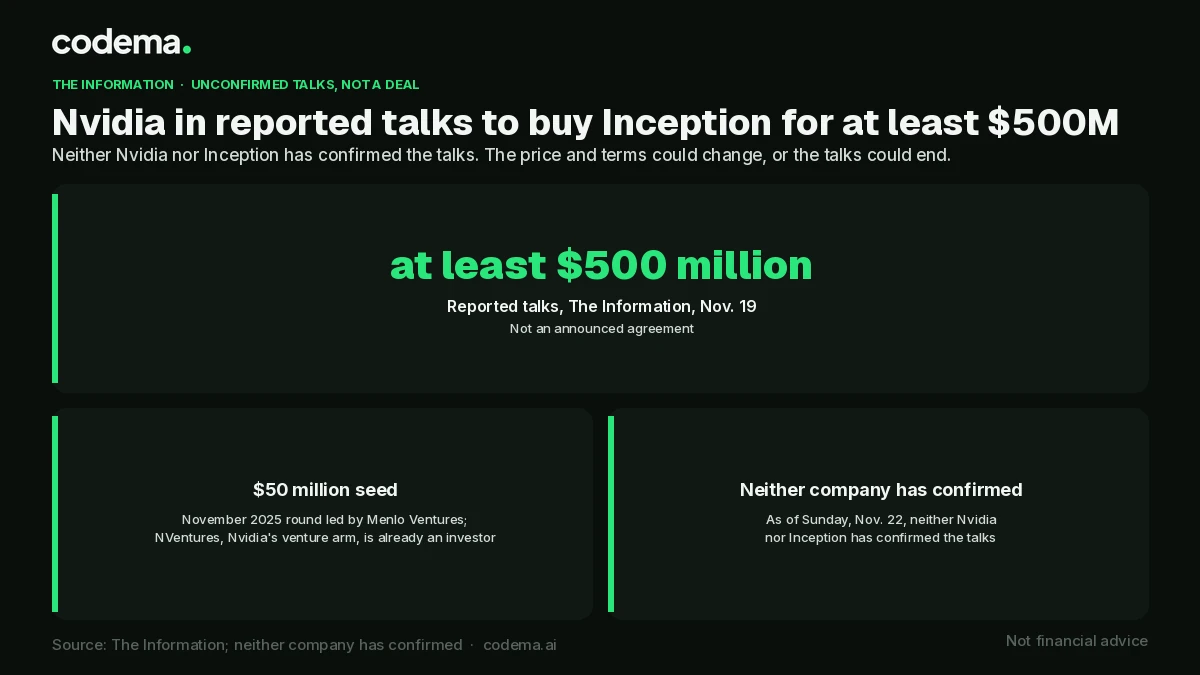
As of Sunday, Nov. 22, neither Nvidia nor Inception has confirmed the talks. Neither company commented when the report came out, and we found no announcement from either since. Until a deal is signed and announced, the price and terms could change, or the talks could end.
What the report says
According to The Information's report, as summarized by The Decoder and Tech Funding News:
- Price: at least $500 million, plus earnouts tied to performance targets for employees.
- People: all three co-founders, Stefano Ermon (Stanford, CEO), Aditya Grover (UCLA) and Volodymyr Kuleshov (Cornell), are expected to join Nvidia full time.
- Purpose: the team and technology could help build out Nvidia's Nemotron open models and its physical models for robots.
- Timing: the talks began before Jensen Huang stepped down as Nvidia's CEO, and after Microsoft had shown interest in Inception.
That means the talks have continued through the leadership change that followed Huang's Nov. 12 resignation. CFO Colette Kress is serving as interim CEO.
What Inception does
Most language models, including the ones behind ChatGPT and Claude, write text one token at a time. Inception's diffusion models start from a rough draft of many tokens and refine them in parallel, which the company says makes them much faster and cheaper to run. Our diffusion LLMs explainer covers how that works.
Its latest model, Mercury 3, came out on Oct. 19. Inception says it runs at 1,068 tokens per second on Nvidia GPUs with a 1M-token context. Those are the company's own figures.
Inception raised a $50 million seed round in November 2025 led by Menlo Ventures, with Mayfield, Innovation Endeavors, Microsoft's M12, Snowflake Ventures, Databricks Investment and NVentures, Nvidia's venture arm, according to its announcement. So Nvidia is already an investor.
Why it fits Nvidia
Nvidia sells the GPUs most AI models run on, but it also publishes its own open models. Its Nemotron 3.5 family, which we covered in our Nemotron explainer, targets agents and runs from data centres down to RTX PCs. A diffusion team would give Nvidia a different way to make those models faster on its own hardware.
For builders, the practical question is what happens to Mercury, which is available today through Inception's API and other platforms. Nothing has been said about that, because nothing has been announced. For background on how model families and architectures compare, see our AI models explained guide, and for other deals we are tracking, our deals and IPOs hub.
Sources
- The Information: Nvidia Nears Acquisition of Diffusion AI Developer for More Than $500 Million (Nov. 19, 2026)
- The Decoder: Nvidia bets at least $500 million on Inception's diffusion models (Nov. 20, 2026)
- Tech Funding News: Report: Nvidia in advanced talks to acquire Stanford-led diffusion AI startup Inception for $500M+ (Nov. 20, 2026)
- Business Wire: Inception Raises $50M to Power Diffusion LLMs (Nov. 6, 2025)
- Inception: Diffusion at Scale: Introducing Mercury 3 (Oct. 19, 2026)
FAQ
Is Nvidia buying Inception?
Not officially. The Information reported on Nov. 19 that Nvidia is in advanced talks to buy Inception for at least $500 million, citing three people familiar with the talks. As of Nov. 22, neither Nvidia nor Inception has confirmed a deal, and the talks could still fall apart.
What does Inception make?
Inception builds diffusion language models called Mercury. Instead of writing one token at a time, they draft many tokens and refine them in parallel, which the company says makes them much faster. Mercury 3, released Oct. 19, runs at 1,068 tokens per second on Nvidia GPUs, Inception says.
Why would Nvidia want Inception?
The Information reported that Inception's technology and team could help Nvidia build out its Nemotron family of open models and its physical models for robots. Diffusion models could also generate text faster on the same GPUs, a fit for a company that sells AI hardware.
Who founded Inception?
Inception was founded by Stanford professor Stefano Ermon, its CEO, with Aditya Grover of UCLA and Volodymyr Kuleshov of Cornell. All three are expected to join Nvidia full time if a deal goes ahead, according to The Information's report as summarized by The Decoder.
Sources
- The Information, Nvidia Nears Acquisition of Diffusion AI Developer for More Than $500 Million (Nov. 19, 2026)theinformation.com
- The Decoder, Nvidia bets at least $500 million on Inception's diffusion models to strengthen its open-source Nemotron lineup (Nov. 20, 2026)the-decoder.com
- Tech Funding News, Report: Nvidia in advanced talks to acquire Stanford-led diffusion AI startup Inception for $500M+ (Nov. 20, 2026)techfundingnews.com
- Business Wire, Inception Raises $50M to Power Diffusion LLMs (Nov. 6, 2025)businesswire.com
- Inception, Diffusion at Scale: Introducing Mercury 3 (Oct. 19, 2026)inceptionlabs.ai
Topics
Kelly B.AI Money desk
Kelly B. is a Codema.ai house byline: a pen name used by our editorial desk, not one individual journalist. It covers Hardware & Infra: GPUs and the memory inside them (HBM, GDDR7, DDR5, NAND), hardware for running AI locally, GPU rental prices, chipmaking, and the data centres and power behind AI. Pieces under this name are written with AI assistance and reviewed by a human editor before they're published.
All stories by Kelly B.