
Part of our AI models explained: ChatGPT, Claude, Gemini and the rest guidePart of our Coding agents explained: Claude Code, Cursor, Codex and how to choose guide
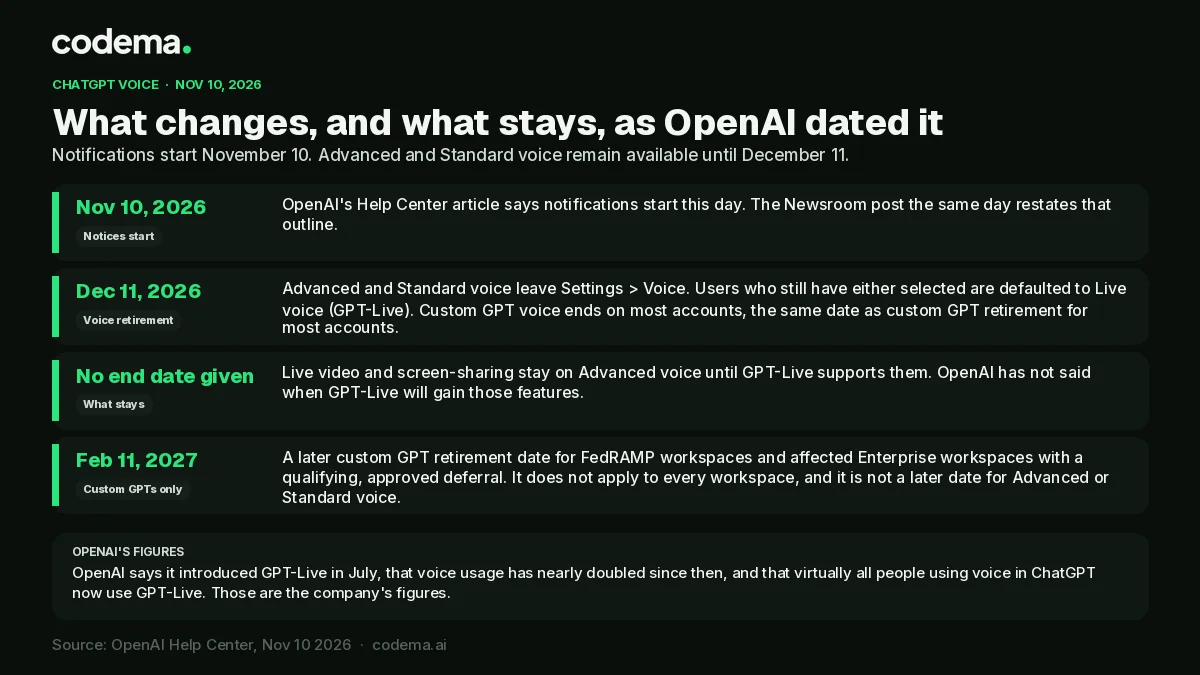
OpenAI will retire ChatGPT Advanced and Standard voice on December 11, 2026, and move users who still have either one selected to GPT-Live, according to a Help Center article that says notifications start November 10. Until December 11, users can keep using Advanced or Standard voice. Live video and screen-sharing will stay on Advanced voice until GPT-Live supports them.
What changes for you
On December 11, Advanced and Standard voice will disappear from the model picker in Settings > Voice, and anyone who still has one of those selected will be defaulted to Live voice. Conversations already in your ChatGPT history stay there and can be continued in text or voice, but spoken continuations will use GPT-Live after that date. If you need live video or screen-sharing, those features remain on Advanced voice for now; OpenAI has not said when GPT-Live will gain them. Voice with custom GPTs also stays on Advanced voice until December 11, 2026, the same date OpenAI has scheduled for custom GPT retirement on most accounts.
The Help Center article is the primary source. OpenAI Newsroom posted the same outline on November 10, 2026, and linked back to that article. OpenAI says it introduced GPT-Live in July, that voice usage has nearly doubled since then, and that "virtually all people using voice in ChatGPT now use GPT-Live." Those are the company's figures; the article does not define the comparison period beyond the July launch or give an absolute number of voice users.
GPT-Live is described as a full-duplex model, meaning it can listen and speak at the same time, including brief acknowledgments or staying quiet. Advanced voice was turn-based: it processed audio natively but waited for the user to stop speaking. Standard voice chained speech-to-text, a language model, and text-to-speech, which OpenAI says led to slower responses and lost information between voice and text. GPT-Live can also "delegate complex questions or agentic tasks to our frontier text models" and keep the conversation going while those run in the background. Codema's Models & LLMs hub follows this kind of ChatGPT model change, and our Agents hub is where we follow the packaged, multi-step work GPT-Live can hand off to frontier text models. Our explainer on agent harnesses covers the tooling around a model when the job is more than a single reply.
What to watch is the gap the announcement leaves open. OpenAI has not given a date for live video or screen-sharing on GPT-Live, so it is not yet clear whether those features will still depend on Advanced voice after December 11. The voice article also points to a separate custom GPT retirement and migration FAQ: custom GPTs are scheduled to retire on December 11, 2026, with a later date of February 11, 2027, for FedRAMP workspaces and affected Enterprise workspaces that have a qualifying, approved deferral. That later date does not apply to every workspace. Users who want a copy of their data can follow OpenAI's existing export process, which the voice article links out to. During the transition, Advanced and Standard voice remain available in the picker; after December 11, they will not.
FAQ
When are ChatGPT Advanced and Standard voice going away?
On December 11, 2026. Until then users can keep using either one. After that date they disappear from the model picker in Settings > Voice, and anyone who still has one selected is defaulted to Live voice.
What happens to my existing voice conversations?
Conversations already in your ChatGPT history stay there and can be continued in text or voice. After December 11, spoken continuations will use GPT-Live.
Will live video and screen-sharing still work?
Those features stay on Advanced voice until GPT-Live supports them. OpenAI has not said when that will be, so it is not yet clear whether they will still depend on Advanced voice after December 11.
What is GPT-Live?
OpenAI describes it as a full-duplex model, meaning it can listen and speak at the same time. It can also "delegate complex questions or agentic tasks to our frontier text models" and keep the conversation going while those run.
What happens to voice with custom GPTs?
It stays on Advanced voice until December 11, 2026, the same date OpenAI has scheduled custom GPT retirement on most accounts. A later date of February 11, 2027, applies to FedRAMP workspaces and affected Enterprise workspaces with a qualifying, approved deferral.
Sources
Topics
John F.AI desk
John F. is a Codema.ai house byline: a pen name used by our editorial desk, not one individual journalist. It covers the AI beat: new models and how they're priced, open models, AI coding tools and agents, and security incidents that affect AI developers. Pieces under this name are written with AI assistance and reviewed by a human editor before they're published.
All stories by John F.